



A Mysterious Glow in Our Galaxy
Scientists are buzzing about a mysterious source of high-energy light that appears to be located within our own Milky Way galaxy. The source, known as HESS J1507−622, was first detected years ago by the High Energy Stereoscopic System (H.E.S.S.) in Namibia.
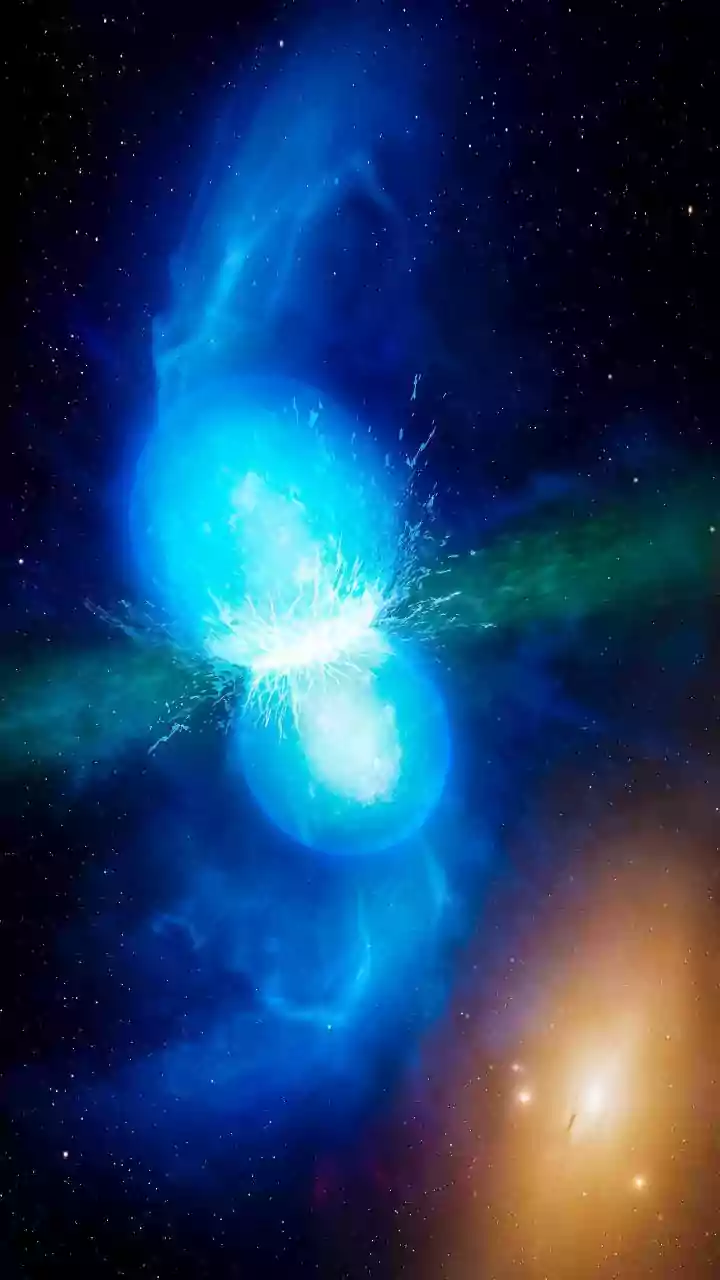
It stood out because it glowed brightly in gamma rays but had no visible counterpart in other wavelengths like X-rays or radio waves. A new, not-yet-peer-reviewed study from a team of Chinese and US researchers proposes a tantalizing origin story: this glow is the young remnant of a kilonova, a cataclysmic explosion caused by the merger of two neutron stars. If confirmed, it would be the first such event identified within our home galaxy.
The Universe’s Ultimate Forges
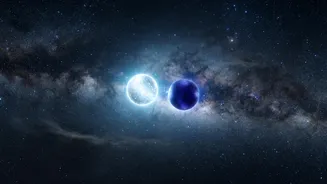
So, what exactly is a neutron star? It's the incredibly dense core left behind after a massive star collapses and explodes. Just a teaspoon of neutron star material would weigh about a billion tonnes. When two such objects orbit each other, they gradually spiral inwards and eventually collide in a spectacular event known as a kilonova. These mergers are cosmic factories, responsible for creating many of the universe’s heaviest elements—including gold, platinum, and uranium—through a process of rapid neutron capture. For a brief period, this explosion can unleash a flash of gamma rays and an afterglow that is thousands of times brighter than a typical nova. This process has long been theorized, but it was spectacularly confirmed in 2017 with the observation of a distant kilonova known as GW170817, which produced both gravitational waves and a rich signature of heavy elements.
An Event in Our Galactic Backyard
The new research suggests that HESS J1507−622 is the aftermath of a similar collision that happened relatively recently, perhaps less than 1,000 years ago. The remnant's small size and brightness are key clues pointing to its youth. Researchers calculated that such an event would produce energetic particles that would interact with their surroundings, creating the exact kind of gamma-ray emissions observed by the H.E.S.S. telescopes. The location of the source, away from the crowded main plane of the Milky Way, also fits the profile for a neutron star merger. Binary star systems can get a powerful 'kick' during their formation, sending them into unusual orbits outside the galaxy's busiest regions.
The Puzzle of the Missing Gold
This is where the story takes a fascinating turn, as indicated by the headline. While kilonovae are considered the primary source of gold in the universe, direct evidence of these heavy elements has not yet been confirmed for this specific event. The initial gamma-ray flash itself, which would have been visible from Earth, seems to have gone unrecorded. Researchers note that while it might have been as bright as Jupiter in our sky, its likely position in the southern sky would have made it difficult to see for ancient astronomers in the Northern Hemisphere who kept detailed records. The absence of a confirmed 'smoking gun'—like a direct spectral signature of gold or platinum in the remnant's glow—makes this a compelling puzzle. It suggests that not all neutron star mergers behave in the same way. The event might have produced different ratios of elements than expected, or the conditions of this particular collision were unique.