
A Famous Star with a New Secret
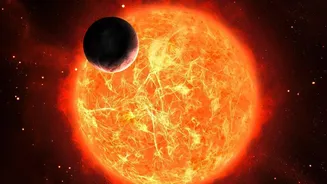
Imagine a star system just 63 light-years away, a mere stone’s throw in cosmic terms. This is Beta Pictoris, a young, vibrant star only about 23 million years old. For decades, it has been a go-to laboratory for scientists studying how planets are born.
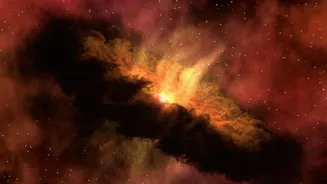
It’s surrounded by a huge, bright disc of dust and gas—the raw materials for planet-making. Astronomers had already found two massive planets here: Beta Pictoris b, one of the first exoplanets ever directly photographed, and Beta Pictoris c, detected by the wobble it induces in its star. Now, a third giant has joined the family: Beta Pictoris d.
Meet Beta Pictoris d
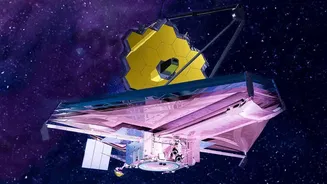
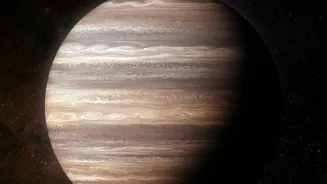
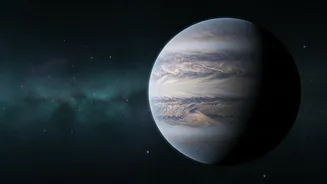
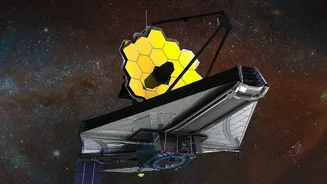
The newcomer, Beta Pictoris d, is a heavyweight, estimated to be at least two times the mass of our own Jupiter. However, it's actually the smallest of the three gas giants known to orbit the star. It circles its star at a distance comparable to Neptune's orbit in our solar system, much farther out than its siblings. The discovery was made by two independent teams of astronomers. One team, using the JWST, wasn't even looking for a new planet; they were studying the atmosphere of the known planet, Beta Pictoris b, when the unexpected signal for 'd' appeared in their data. Another team spotted it using the European Southern Observatory's Very Large Telescope (VLT) and, upon checking archival data, realised the planet had been faintly visible in images for over a decade, hiding in plain sight.
A New Way to Find Planets
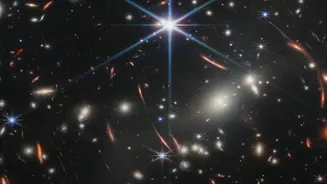
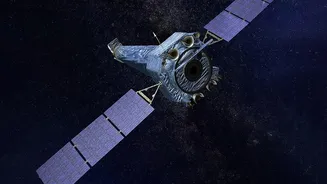
Spotting the planet wasn't as simple as seeing a point of light. The star's dusty debris disc creates a bright fog that makes traditional imaging incredibly difficult. This is where the power of the James Webb Space Telescope came into play. Instead of just taking a picture, scientists used its advanced spectrographs, specifically the NIRSpec instrument. A spectrograph splits light into its component wavelengths, like a prism creating a rainbow. By doing this, the team could look for the unique chemical 'fingerprint' of a planet's atmosphere. They found the tell-tale signature of carbon monoxide, and later water and methane, which could only belong to a massive planet. This spectroscopic technique allowed them to effectively see through the dust and confirm the planet's existence by its chemical composition and motion, proving it was gravitationally tied to the star.
Why This Discovery Matters
Finding Beta Pictoris d is more than just adding another exoplanet to the catalogue. Its existence helps solve a long-standing mystery. Astronomers had noticed that the inner edge of the star's debris disc seemed to be 'sculpted' or cleared out, and they suspected a planet was responsible. Beta Pictoris d, with its specific mass and orbit, appears to be exactly the right candidate for the job. Furthermore, finding a third giant planet in one system is rare; Beta Pictoris is only the second system where three planets have been directly imaged. This gives scientists an unprecedented opportunity to study multiple giant planets that all formed in the same environment, offering crucial clues about the complex processes of planetary formation.