

Redefining Our Cosmic Backyard
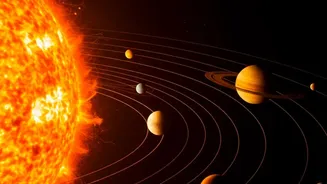
A new theory put forward by former NASA chief scientist Jim Green and mathematician Ed Belbruno suggests our solar system’s true boundary is defined not by planets or solar wind, but by the limit of the Sun’s gravitational dominance. This 'Solar Gravitational
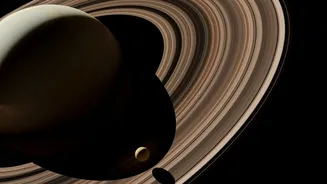
Frontier' is the point where the Sun's pull is finally balanced by the gravitational forces of the Milky Way galaxy itself. According to their calculations, this frontier lies an astonishing 3.8 light-years away from the Sun. To put that into perspective, the nearest star system, Alpha Centauri, is about 4.2 light-years away. This new definition suggests our solar system is not an isolated island but a vast sphere of influence that nearly touches our stellar neighbors.
Not the Heliosphere, But Gravity’s Edge
It’s easy to get confused by the different 'edges' of the solar system. Many people are familiar with the heliopause, the boundary that NASA's Voyager 1 and 2 probes crossed in 2012 and 2018, respectively. The heliopause marks the edge of the heliosphere—a massive magnetic bubble created by the solar wind, which is a stream of charged particles flowing from the Sun. Crossing it means entering interstellar space, where the particles and magnetic fields from other stars dominate. However, leaving the Sun's magnetic bubble is not the same as escaping its gravity. The Voyager probes, while technically in interstellar space, are still firmly within the Sun’s gravitational grip and will be for thousands of years. The newly proposed frontier is about gravity, which has a much longer reach.
A Dance of Galactic Forces
So how did Green and Belbruno arrive at 3.8 light-years? Their model considers the solar system not in isolation, but as part of the larger Milky Way galaxy. The Sun orbits the galactic center, and its gravity has to compete with the collective pull of all the other stars, gas, and even dark matter in the galaxy. The researchers argue that the boundary isn’t a sharp line but a complex zone where these forces find a delicate equilibrium. Using principles from a concept known as weak stability boundary theory—previously used to find fuel-efficient paths to the Moon—they identified the region where an object is no longer stably bound to the Sun and can be influenced by the galaxy's tidal forces. This calculation gives us a new sense of the sheer scale of the Sun’s dominion.
Cosmic Gateways and Hidden Worlds
This expanded view of the solar system has exciting implications. The theory suggests the existence of stable gravitational points, known as Lagrange points, in this far-flung region. These points could act as 'gateways', capturing slow-moving interstellar objects that wander too close. This might explain how our solar system acquires interstellar visitors. This vast territory is also thought to be the home of the Oort Cloud, a theoretical sphere of trillions of icy objects believed to be the source of long-period comets. While estimates for the Oort Cloud's size vary, this new 3.8 light-year frontier provides a more defined outer limit for where these objects might be found. Researchers are even considering using probes like New Horizons to study dust in these distant regions to verify their calculations.
A Journey We Can’t Yet Make
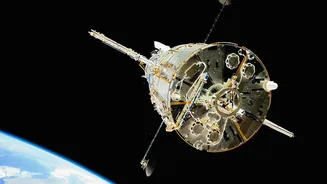
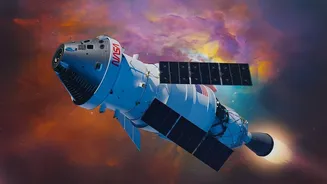
While this new definition expands our cosmic address, it also highlights the immense challenge of exploration. As of late 2026, Voyager 1, humanity's most distant object, is still less than one light-day from Earth—a tiny fraction of the distance to this gravitational frontier. At its current speed, it would take Voyager 1 about 300 years just to reach the inner edge of the Oort Cloud, and an estimated 30,000 years to cross it entirely. Reaching the Sun's gravitational boundary would take even longer. This frontier is not a destination for today’s spacecraft, but a theoretical concept that re-frames our place in the universe. It reminds us that even after decades of exploration, our home system remains a profoundly vast and mysterious place, its true boundaries only now coming into focus.