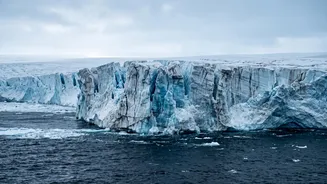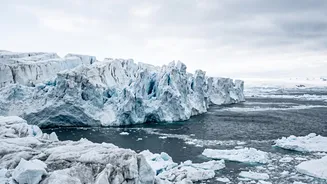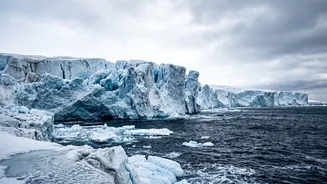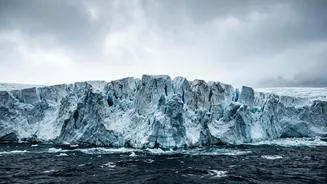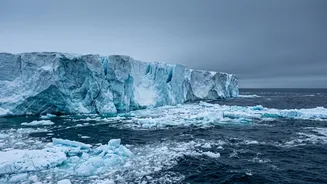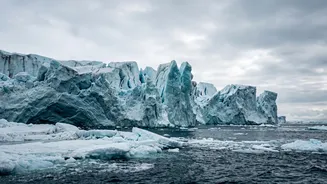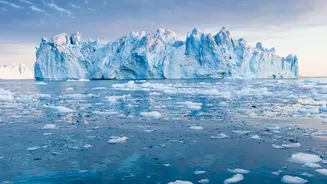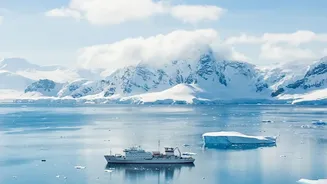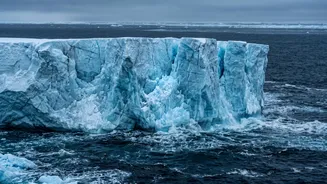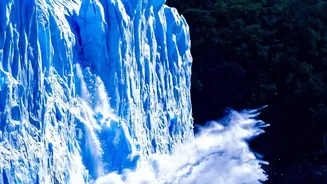



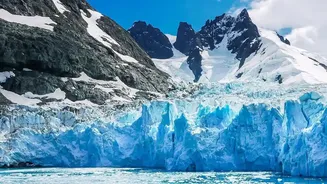
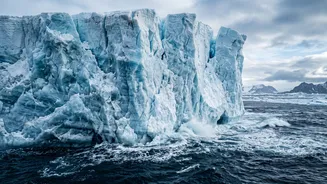
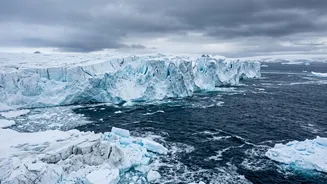
Antarctica's Thwaites Glacier, nicknamed the 'Doomsday Glacier' for its catastrophic potential, is melting faster than feared. New scientific modelling reveals a startling forecast, doubling its projected contribution to sea-level rise by 2100.
The Florida-Sized Problem in Antarctica
Thwaites
Glacier, located in West Antarctica, is one of the largest and fastest-melting glaciers on Earth. Spanning an immense 192,000 square kilometres, it is roughly the size of Florida or Great Britain. Its alarming nickname, the 'Doomsday Glacier', isn't for dramatic effect; it’s a reflection of its critical role in global sea-level stability. Currently, its melting ice is responsible for about 4% of annual global sea-level rise. More importantly, Thwaites acts as a natural dam, holding back the rest of the vast West Antarctic Ice Sheet. Scientists have long understood that if Thwaites were to collapse entirely, it would raise global sea levels by over two feet (about 65 cm). But the real catastrophe is that its failure would destabilise the surrounding ice, potentially leading to a total sea-level rise of around 10 feet in the centuries to follow, which would reshape coastlines worldwide.
What the New Model Reveals
Recent research from glaciologists at the University of California, Irvine, and NASA's Jet Propulsion Laboratory has provided a sobering update. Using a new, more sophisticated computer model, they project that Thwaites' contribution to sea-level rise by 2100 could be up to 30 millimeters (1.2 inches). This figure is double what previous models had estimated. The most concerning aspect of this finding, published in the journal Nature Communications, is that this accelerated melting could occur even without any further increase in ocean warming. The new model better reflects the complex reality of how warm ocean water is interacting with the base of the glacier, a process that previous estimates appear to have significantly underestimated.
Melting From Below
The primary cause of the glacier's rapid retreat is not warm air melting the surface, but warmer ocean water attacking it from underneath. The base of Thwaites rests on bedrock that is below sea level, a formation that makes it inherently unstable. The key insight from the new model is its treatment of the 'grounding zone'—the area where the glacier transitions from resting on land to floating on water. Instead of a single, fixed line, scientists now understand this is a wide zone, sometimes several kilometres across. Tides push warm, salty ocean water deep into this zone, melting the ice from the base in a process of 'vigorous melting' that was not fully accounted for in older projections. This underwater melt is causing the glacier to unpin from the seabed and accelerate its flow towards the sea.
An Unstable Anchor
A critical feature holding Thwaites in place is an underwater mountain known as the Mouginot Ridge. This ridge acts as a stabilizing anchor, slowing the glacier's slide into the ocean. However, the intense basal melting is weakening this connection. The new simulations show a 60% probability that Thwaites will become fully detached from this stabilizing ridge before the year 2100. Once that happens, the glacier's retreat is expected to speed up considerably as it slides down a 'retrograde slope'—ground that gets deeper further inland, exposing even more ice to warm ocean water. Some studies have indicated this process of accelerated melting may have begun as far back as the 1940s, committing the glacier to a certain amount of ice loss regardless of future climate action.
What It Means for India's Coastline
While 30 millimeters might not sound like much, it represents a significant increase in the baseline sea level that magnifies the impacts of storm surges and high tides. For a country like India with a 7,500nd kilometre coastline and densely populated coastal cities like Mumbai, Chennai, and Kolkata, every millimeter matters. Rising sea levels directly translate to increased risks of coastal flooding, erosion, and saltwater intrusion into freshwater sources, threatening infrastructure, agriculture, and the livelihoods of millions. The updated projections for Thwaites underscore the urgency of reinforcing coastal defences and developing longterm adaptation strategies. The fate of a single, remote glacier in Antarctica has direct and tangible consequences for communities thousands of kilometres away.