



The Great Lunar Blackout
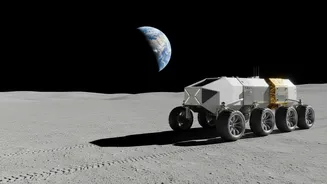
The challenge is simple physics: the massive body of the Moon itself blocks direct radio signals from Earth. Any astronaut or rover that ventures onto the far side, or into deep craters at the poles, enters a communications blackout zone. During the Apollo
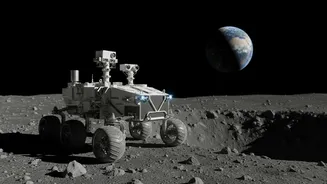
era, astronauts experienced this silence for approximately 41 minutes on each pass behind the Moon. For short missions, this was a manageable risk. But for NASA’s Artemis program, which aims to establish a sustainable human presence and a future Moon Base, intermittent contact is not an option. Continuous communication is essential for astronaut safety, complex scientific experiments, and controlling advanced robotics on the treacherous lunar surface.
A Celestial Internet Service
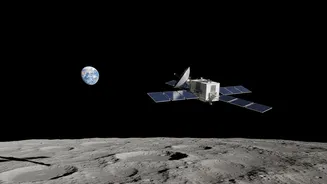
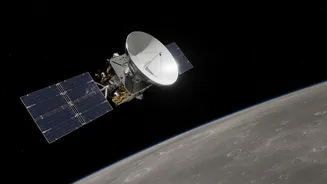
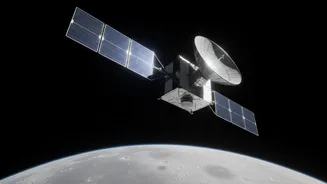
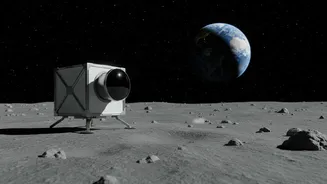
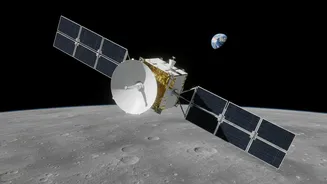
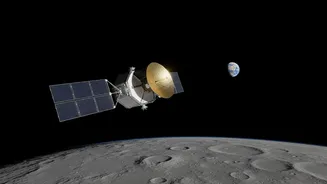
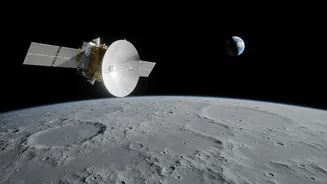
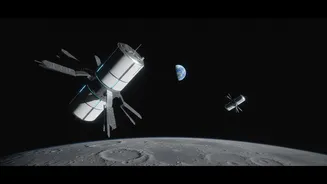
NASA's solution is the Lunar Communications Relay and Navigation Systems (LCRNS) project. Think of it as building an internet and GPS service provider for the Moon. The plan involves placing a network of satellites in lunar orbit that will act as communication relays. A lander on the far side will send its signal up to a relay satellite, which will then bounce that signal back to a ground station on Earth, bypassing the Moon as a physical obstacle. This system will not only provide a continuous link but also enable higher data rates—think high-definition video instead of grainy images—and precise navigation services for missions on the surface and in orbit. This robust infrastructure is considered a mission-enabler, unlocking the potential for more ambitious science and exploration.
A Public-Private Partnership
To build this lunar network, NASA is not going it alone. Instead, it is acting as a customer, fostering a new commercial space economy. Through its Commercial Lunar Payload Services (CLPS) initiative, the agency is partnering with private industry. Companies like Intuitive Machines and Firefly Aerospace are developing the satellites and landers that will form this network. For example, the European Space Agency's (ESA) Lunar Pathfinder satellite, built by UK-based SSTL and set to launch as soon as late 2026, is a key early component. It will launch aboard a Firefly Aerospace Blue Ghost mission. In July 2026, NASA delivered a critical navigation payload, the NavCube3-mini, for integration into an Intuitive Machines relay satellite, marking a tangible step toward this goal. This commercial approach is designed to be more flexible, spur innovation, and reduce costs.
Unlocking the Secrets of the Far Side
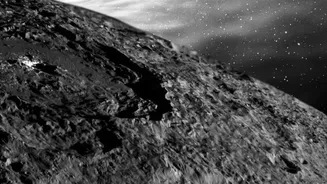
With a reliable communication link, the scientific goldmine of the lunar far side finally becomes accessible. Shielded from the constant radio noise of Earth, this region is the most pristine environment in our cosmic neighborhood for radio astronomy. Scientists dream of placing telescopes there to listen for faint signals from the early universe that are impossible to detect from Earth. The far side's heavily cratered surface is also a preserved record of the solar system's history. Furthermore, key areas like the South Pole-Aitken Basin, a massive and ancient impact crater, are believed to hold vast quantities of water ice and other resources that could be vital for future long-term habitats. These relay satellites are the key that will unlock our ability to explore these scientifically rich and resource-abundant regions safely and effectively.