




Our Sun's Protective Bubble
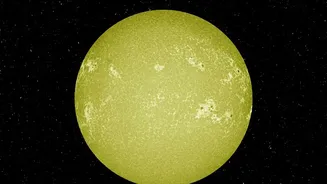
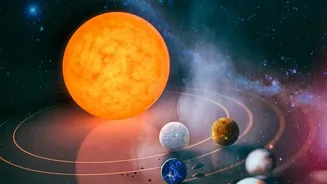
Imagine the sun constantly blowing a giant, magnetic bubble around all the planets. This stream of charged particles is called the solar wind, and the bubble it creates is the heliosphere. For a long time, scientists considered the edge of this bubble,
known as the heliopause, to be the functional border of our solar system. This is the point where the solar wind is no longer strong enough to push back the material from interstellar space—the vast expanse between stars. The Voyager 1 and 2 spacecraft famously crossed this boundary, sending back data from what we considered the frontier. The heliosphere acts as a crucial shield, protecting Earth and the other planets from a significant amount of harsh cosmic radiation streaming in from the galaxy.
The Universe's Invisible Architect
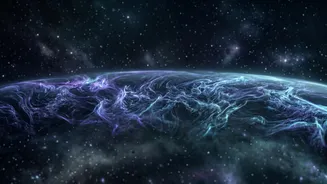
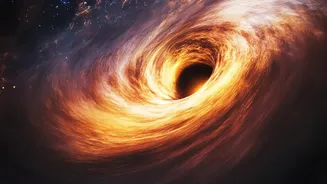
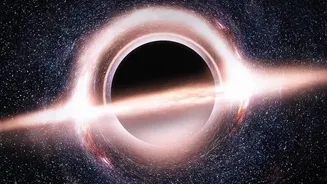
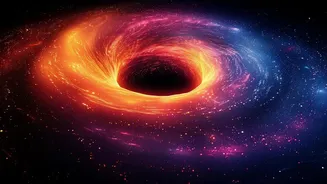
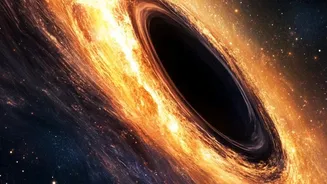
Now, let's talk about dark matter. It's one of the biggest mysteries in modern physics. We can't see it, touch it, or detect it directly because it doesn't interact with light or any form of electromagnetic radiation. Yet, scientists are confident it exists. Its presence is inferred from its immense gravitational effects on the things we can see. For instance, stars at the edges of galaxies rotate far too quickly to be held in place by the gravity of visible matter alone. There must be something else providing the extra gravitational glue, and that 'something' is dark matter. It's believed to make up about 85% of all matter in the universe, forming a vast, invisible scaffold upon which galaxies are built.
A New Model Redefines the Edge
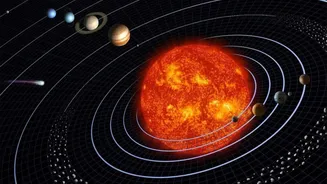
A new theory, proposed by former NASA chief scientist Jim Green and mathematician Ed Belbruno, challenges the old definition of our solar system's edge. They argue that the boundary isn't just about where the solar wind stops. Instead, it's a far more complex and distant frontier where the gravitational pull of our sun finally gives way to the broader gravitational force of the entire Milky Way galaxy. And a huge component of that galactic force comes from its massive halo of dark matter. While dark matter's density is extremely low within our solar system, its cumulative gravitational pull becomes significant over vast distances. This model suggests the solar system's true gravitational frontier extends out to nearly 3.8 light-years, much farther than the heliopause.
Connecting Dark Matter to Our Cosmic Neighbourhood
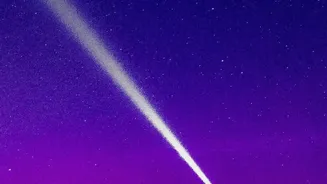
So how does this work? The model posits that as an object gets farther from the sun, the sun's gravitational pull weakens. At extreme distances, the combined gravity of the Milky Way, dominated by its dark matter halo, starts to take over. This galactic force, however faint, is enough to influence the trajectory of objects in the outer solar system over millions of years. Green and Belbruno suggest this could explain the unusual orbits of some distant objects and may have even pushed comets from the Oort Cloud—a theoretical shell of icy bodies at the solar system's furthest reach—out of the sun's orbit entirely. Their work implies that the paths of future long-range spacecraft will need to account for the subtle but persistent tug of dark matter.
Why This New Perspective Matters
This re-framing of our solar system's boundary isn't just an academic exercise. It represents a deeper understanding of our place in the galaxy. It acknowledges that our solar system isn't an isolated island but is deeply embedded within and influenced by the larger galactic environment. Understanding this connection could have profound implications. For one, it could help in the search for the hypothetical Planet 9, as dark matter's gravity could be affecting its orbit. Furthermore, it provides a new way to potentially study dark matter itself. By precisely measuring the trajectories of future interstellar probes, scientists might be able to detect the tiny deviations caused by dark matter's gravity, giving us a new tool to probe this invisible substance. This model blurs the line between solar and galactic physics, opening up exciting new avenues for discovery.