



Why Cabins Are Pressurised
Commercial jets fly at altitudes between 30,000 and 42,000 feet to take advantage of thinner air, which reduces drag and saves fuel. However, the air at these heights is too thin for humans to breathe. To solve this, the aircraft's cabin is pressurised.
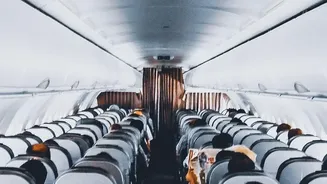
Air is 'bled' from the engines, cooled, and pumped into the sealed fuselage to create a safe and breathable environment. This system maintains the cabin at a pressure equivalent to an altitude of around 6,000 to 8,000 feet, which your body can comfortably handle. Think of it as creating a low-altitude bubble flying through the upper atmosphere.
When Pressurisation Fails
A loss of cabin pressure, or depressurisation, is an uncommon event but can happen for several reasons, such as a faulty door seal, a malfunction in the pressurisation system, or structural damage. This can be gradual (insidious), where the pressure drops slowly, or rapid, often accompanied by a loud bang and a sudden drop in temperature. The primary danger in this scenario isn't the pressure change itself, but the resulting lack of oxygen, a condition called hypoxia. At high altitudes, a person can lose useful consciousness in seconds without supplemental oxygen.
The First Response: Oxygen Masks
When the cabin altitude exceeds a preset limit (typically around 14,000 feet), oxygen masks automatically drop for passengers and crew. This is the critical first line of defence. The masks provide a temporary supply of breathable air, designed to keep everyone safe and conscious for the crucial next phase of the procedure. This is why the pre-flight safety briefing always stresses putting your own mask on first; you cannot help others if you are affected by hypoxia. The oxygen supply is intended to last long enough for the pilots to get the aircraft down to a safe altitude.
The Pilots' Main Task: A Rapid Descent
With everyone on oxygen, the pilots' immediate and most important job is to get the aircraft down to an altitude where the air is thick enough to breathe without assistance. That magic number is generally 10,000 feet. To do this, they initiate an emergency descent, a standard and frequently practised manoeuvre. They reduce engine power to idle, often extend speed brakes or landing gear to increase drag, and point the nose down. The goal is to descend as quickly as is safely possible, often at rates of 5,000 feet per minute or more, compared to a normal descent of 1,000-2,000 feet per minute.
Why It Feels Alarming But Is Perfectly Safe
For passengers, the steep angle and high rate of descent can feel like a 'plunge' or a 'nosedive'. However, this is a highly 'controlled' part of the procedure. The pilots are not reacting in a panic; they are executing a by-the-book plan. They are in constant communication with Air Traffic Control to ensure the descent path is clear of other aircraft and obstacles like mountains. The aircraft is flown within its structural limits and remains fully under the pilots' command throughout the manoeuvre. The rapid part is the solution, not part of the problem. It is the quickest way to get everyone to breathable air.
What Happens After the Descent
Once the aircraft levels off at or below 10,000 feet, the immediate danger has passed. Passengers and crew can breathe normally without masks. At this point, the flight crew will assess the situation. They will check for any damage to the aircraft, communicate with the cabin crew, and determine the next course of action. In nearly all cases, the flight will divert to the nearest suitable airport for a landing. Technicians will then inspect the aircraft to find and fix the source of the pressurisation problem before it is cleared to fly again.