




The Elusive Cosmic Ghost
They are called neutrinos, but 'ghost particles' captures their nature perfectly. Produced in the heart of stars and other cataclysmic cosmic events, these fundamental particles have almost no mass and no electric charge. This means they travel across
the universe in a straight line, unimpeded by matter or magnetic fields, passing through planets, stars, and entire galaxies as if they were not there. While this makes them pristine messengers carrying secrets from the farthest reaches of space, it also makes them incredibly difficult to detect. For every trillion neutrinos that pass through the Earth, only a handful will ever interact with an atom, leaving a faint trace for scientists to find.
A Needle in a Cosmic Haystack
Detecting a neutrino is a monumental task. The IceCube Neutrino Observatory, a massive detector buried a mile deep in the Antarctic ice, uses over 5,000 sensors to watch for the telltale flash of blue light created when a neutrino occasionally collides with an ice molecule. On September 22, 2021, IceCube detected just such a flash from an exceptionally high-energy neutrino, catalogued as IC 210922A. The detector could tell the direction it came from, pointing astronomers to a patch of sky in the constellation Eridanus. Immediately, observatories around the world turned their telescopes to the area, searching for a visible source like an exploding star or a black hole tearing matter apart. They found nothing; the sky was surprisingly quiet.
The Prime Suspect: A 'Shadow Blaster' Galaxy
Undeterred, a team led by researchers from MITOS Science Co. used telescopes like the Atacama Large Millimeter/submillimeter Array (ALMA) to search the region at longer wavelengths, which can peer through cosmic dust. Their search led them to an extremely bright but dust-shrouded galaxy, nicknamed 'Shadow Blaster', located an astonishing 11 billion light-years away. Previously, the few known sources of high-energy neutrinos were blazars—galaxies with supermassive black holes at their centers shooting out powerful jets of particles. But observations of Shadow Blaster showed no evidence of a central black hole engine. Instead, they found signs of something else: incredibly intense and compact star formation.
A New Kind of Cosmic Engine
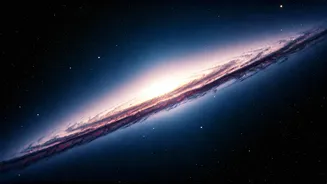
The discovery suggests an entirely new source for some of the universe's most energetic particles. Shadow Blaster is a 'starburst' galaxy, a cosmic factory creating stars at a furious rate. Researchers believe the dense, gas-rich environment at the galaxy's core is so extreme that it acts as a natural particle accelerator, producing the high-energy neutrinos. This finding was aided by a cosmic coincidence known as gravitational lensing, where a closer galaxy acted like a natural magnifying glass, allowing astronomers to study the distant Shadow Blaster in unprecedented detail. This new evidence points to a different pathway for neutrino production, one driven not by destructive black holes, but by the creative fervor of star birth.
Rewriting Our Map of the Universe
This breakthrough represents a major step forward in 'multi-messenger astronomy,' where scientists combine data from different cosmic signals—like light and neutrinos—to get a complete picture of an event. Tracing a single ghost particle to its home challenges previous assumptions and opens up a new class of objects to study. Researchers estimate that this type of dusty, star-forming galaxy could be responsible for a significant portion, perhaps up to 20%, of the diffuse background of high-energy neutrinos detected across the universe. This discovery doesn't just solve one mystery; it gives astronomers a powerful new tool to probe the hidden, violent corners of the early cosmos where stars were born.