




Decoding the Red Planet’s Extreme Weather
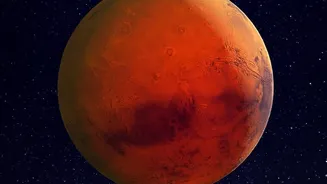
The Martian surface is a place of incredible thermal extremes. Research from scientists at the Physical Research Laboratory (PRL) in Ahmedabad confirms that temperatures can swing wildly, from a relatively mild 27 degrees Celsius in the summer to a bone-chilling
minus 123 degrees Celsius in winter. This vast range is largely due to two factors. First, Mars has an incredibly thin atmosphere, about 100 times less dense than Earth’s. Without a thick atmospheric blanket to trap and circulate heat, the surface warms up rapidly under the sun and loses that heat just as quickly when night falls. Second, Mars has a more elliptical orbit than Earth. During the southern hemisphere's summer, the planet is significantly closer to the sun, leading to much more intense heat compared to the northern summer. This fundamental instability creates a weather system far more volatile than our own.
Beyond Seasons: The Mystery of Zonal Waves
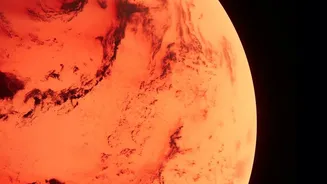
However, the temperature changes on Mars are not just a simple story of day versus night or summer versus winter. The PRL scientists have focused on a more complex phenomenon: zonal waves. Think of these as enormous, continent-sized ripples of thermal energy that travel around the planet. These are not waves in the oceanic sense, but rather organised patterns of warmer and cooler zones that move through the atmosphere, providing an indirect clue to how the planet’s thin air circulates. The study of these waves helps scientists understand the deep atmospheric dynamics of Mars, moving beyond surface-level observations to see how energy is transported on a global scale. These patterns reveal that the Martian climate system is far from random, with organised structures that are influenced by the planet's own features.
An Indian Analysis of International Data
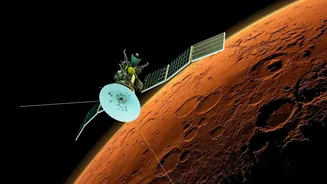
This breakthrough in understanding the Martian climate comes from a uniquely collaborative effort. The team at PRL in Ahmedabad did not use an Indian satellite for this specific study. Instead, they meticulously analysed high-resolution data from the Emirates Mars Infrared Spectrometer (EMIRS), an instrument aboard the United Arab Emirates' Hope spacecraft. This highlights a growing trend in space science where the most significant discoveries come from international cooperation. The ability of Indian scientists to take raw data from another nation's mission and extract such crucial insights demonstrates the country's world-class analytical capabilities. It proves that contributing to space exploration is not only about launching rockets, but also about having the scientific expertise to interpret the information we gather from across the solar system.
How Martian Landscapes Shape the Climate
A key finding from the study, published in the journal Current Science, is the powerful link between Mars's topography and its weather patterns. The researchers focused on two of the largest impact basins on Mars: Hellas and Argyre. They discovered that the shape of the landscape had a profound effect on the zonal waves. The Argyre basin was predominantly influenced by a large, simple wave pattern known as a wave-1. In contrast, the deeper and more complex Hellas basin exhibited more intricate wave-2 and wave-3 patterns, which varied with the seasons. This discovery confirms that the vast craters, canyons, and plains of Mars are not just passive features; they actively shape atmospheric flow and temperature distribution, creating regional weather systems on a planetary scale.
Refining Our Models for Future Missions
Perhaps one of the most practical outcomes of this research is its ability to improve our climate models of Mars. The PRL team compared their real-world observations with the predictions of the widely used Mars Climate Database. They found that while the models correctly predicted the general wave patterns, they were often inaccurate in their temperature readings, sometimes by as much as 10 Kelvin (10 degrees Celsius) cooler than what was actually measured. This is a critical finding. For future robotic and, eventually, human missions to Mars, having precise weather forecasts is not a luxury—it is essential for safety and success. Knowing the exact temperature range is crucial for designing equipment, planning surface operations, and selecting landing sites. This Indian-led analysis provides vital data to fine-tune those models, making future exploration of the Red Planet safer and more effective.