



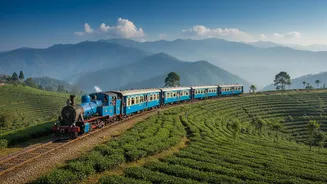
Darjeeling Himalayan Railway: The Original Icon
The first of its kind and a true pioneer, the Darjeeling Himalayan Railway (DHR) has been charming travelers since 1881. It was the first mountain railway in India to be declared a UNESCO World Heritage Site in 1999. This narrow-gauge train travels 88 kilometers
from New Jalpaiguri to Darjeeling, climbing over 7,000 feet. The journey is an engineering marvel, famous for its ingenious loops and zig-zags, like the iconic Batasia Loop, designed to navigate the steep Himalayan terrain. As the tiny steam or diesel engine pulls its carriages through bustling hillside bazaars, dense forests, and verdant tea gardens, passengers are treated to breathtaking views of the snow-capped Kanchenjunga on clear days. It’s not just a train ride; it's a trip back in time.
Kalka-Shimla Railway: A Feat of Engineering
Built in 1903 to connect the summer capital of British India, Shimla, with the plains, the Kalka-Shimla Railway is a testament to ambitious engineering. This 96-kilometer journey was granted UNESCO World Heritage status in 2008, joining its mountain counterparts. What makes this route truly remarkable is its path through 102 tunnels—the longest being the Barog tunnel—and across more than 800 bridges and viaducts. The train winds its way through the Shivalik hills, offering panoramic views of pine forests and rustic villages. The gentle pace allows passengers to soak in the scenery, making the five-hour journey a core part of the Shimla experience itself.
Nilgiri Mountain Railway: Through the Blue Mountains
The 'toy train' of the South, the Nilgiri Mountain Railway (NMR), connects Mettupalayam with the popular hill station of Udhagamandalam, or Ooty. Added to the UNESCO list in 2005, the NMR is unique in India for its use of a rack-and-pinion system to climb the steepest slopes in Asia. This technology allows the train to grip the track on incredibly sharp gradients through the Nilgiri Hills, also known as the Blue Mountains. Completed in 1908, the 46-kilometer journey takes passengers through 16 tunnels, over 250 bridges, and past lush tea plantations. With its vintage blue-and-cream wooden carriages, the NMR offers one of the most picturesque and enchanting rail journeys in the country.
Matheran Hill Railway: A Zig-Zag to Serenity
While the first three form the collective UNESCO site, other heritage lines add to India's rich railway tapestry. The Matheran Hill Railway, a narrow-gauge line in Maharashtra, is a prime example. It covers a 21-kilometer zig-zagging route from Neral to the eco-sensitive hill station of Matheran, where vehicles are banned. Opened in 1907, the journey is known for its sharp curves and a short, charming passage called the 'One Kiss Tunnel'. Though it has faced suspensions due to monsoon damage, this century-old railway remains a beloved attraction and is on UNESCO's tentative list of World Heritage Sites, offering a peaceful, slow-paced entry into the forested hills.
The Enduring Legacy of India's Mountain Rails
More than just modes of transport, India's mountain railways are living museums and marvels of human ingenuity. UNESCO described them as "outstanding examples of bold, ingenious engineering solutions for the problem of establishing an effective rail link through rugged, mountainous terrain." They were built during an era of colonial expansion, opening up remote hill stations for trade, administration, and leisure. Today, they are lovingly maintained by Indian Railways, preserving a vital piece of industrial heritage. These journeys remind us that sometimes, the beauty lies not in reaching the destination quickly, but in the experience of getting there.