





A Breakthrough Discovery 48 Light-Years Away
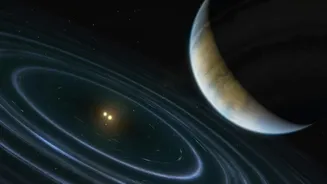
Scientists have announced the first-ever confirmed atmosphere around a temperate, rocky exoplanet, a world named LHS 1140 b. Located about 48 light-years from Earth, this 'super-Earth' is about 70% larger than our own planet and more than five times as
massive. For years, it has been a tantalizing target for astronomers because it orbits within its star's 'habitable zone'—the region where temperatures could potentially allow for liquid water. Now, evidence shows it has managed to hold onto an atmosphere for what may be billions of years, a critical ingredient for life as we know it. The discovery is being hailed as a major turning point, moving the search for life-sustaining planets from theory to direct observation.
How to See an Atmosphere from Trillions of Kilometres Away
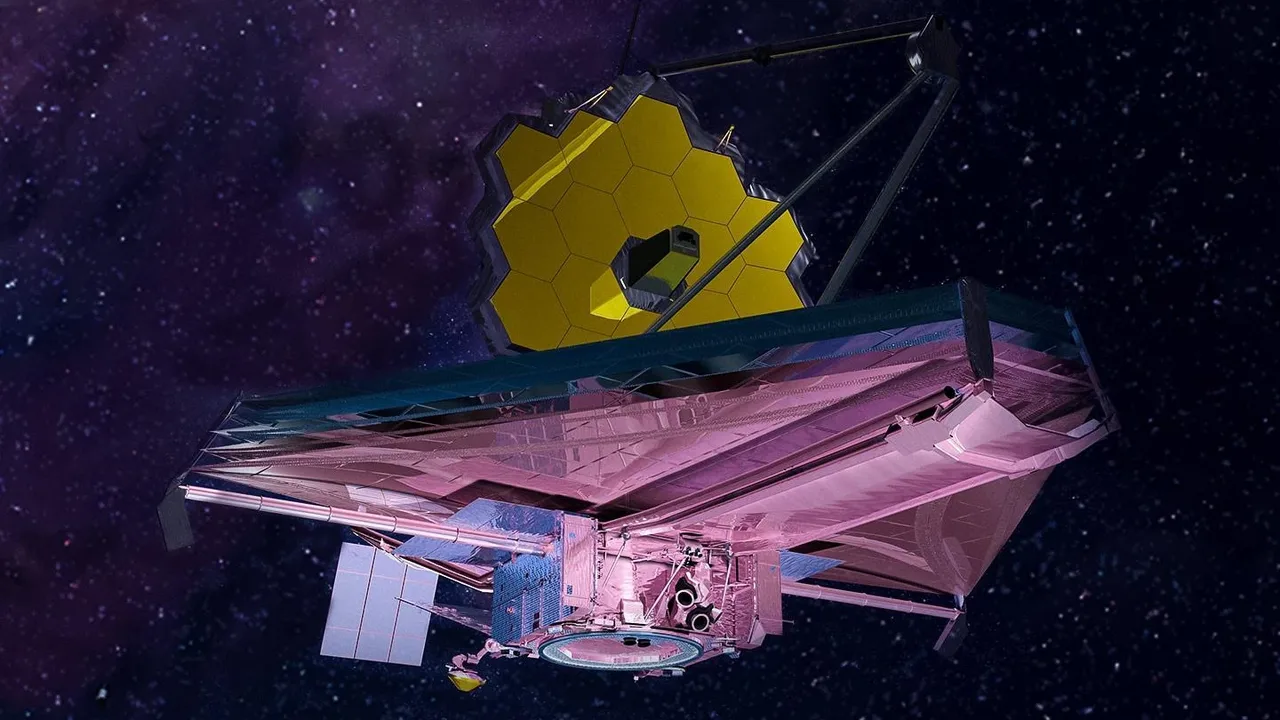
Detecting a thin layer of gas around a small planet so far away is an immense technical challenge. The breakthrough came from detecting helium escaping from the planet's upper atmosphere into space. Using powerful telescopes, likely building on the capabilities of the James Webb Space Telescope (JWST), scientists used a technique called transit spectroscopy. As LHS 1140 b passed in front of its host star, a tiny fraction of starlight filtered through its atmosphere. Different gases absorb light at specific wavelengths, leaving a unique chemical fingerprint. In this case, the signature of helium was unmistakable, providing solid proof that the planet is enveloped in gas. This method validates the models scientists use and proves the technology can find atmospheres on smaller, Earth-like worlds.
A 'Temperate' World, But Not Earth 2.0
While the term 'temperate' sparks excitement, LHS 1140 b is not necessarily a mirror of Earth. It orbits a cool, red dwarf star, which is much dimmer than our sun. To stay warm enough for liquid water, the planet has to orbit much closer to its star than Earth does. The atmosphere itself appears to be dominated by helium, a far cry from Earth’s nitrogen-oxygen mix. However, this helium-rich outer layer could be protecting a more complex atmosphere below, which might contain gases like water vapor. It’s also possible this is a 'secondary atmosphere', formed by ongoing volcanic activity after the planet’s original atmosphere was stripped away. This process, also seen on exoplanet GJ 1132 b, provides a window into the planet's geology.
The Importance of a Scientific Baseline
This discovery's true significance lies in its role as a 'scientific baseline'. For years, astronomers have found atmospheres around massive gas giants, but finding one on a smaller, rocky world in the habitable zone was an elusive goal. LHS 1140 b is now the first confirmed data point, a foundational case study. Scientists can now test their theories about atmospheric evolution and retention on rocky planets against real-world data. It proves that worlds similar in size to Earth can indeed maintain an atmosphere under the right conditions. This finding acts as a crucial signpost, telling researchers what to look for and how to refine their search for even more promising candidates. Every subsequent discovery will be compared to this one, building a library of knowledge about worlds beyond our own.
What Comes Next in the Search for Life?
The confirmation of an atmosphere on LHS 1140 b is not the end of the story; it's the beginning of a new chapter. Astronomers will now intensify their observations of this planet. Using the advanced capabilities of telescopes like JWST, they will probe deeper into the atmosphere, searching for the tell-tale signs of other gases like water vapor, methane, and carbon dioxide. These are the biosignatures that could hint at geological or even biological processes. The discovery energizes the entire field, providing hope that within the thousands of known exoplanets, there are other rocky worlds with atmospheres waiting to be found. Each one brings us a small step closer to finding a planet that is not just habitable, but truly Earth-like.