







The Race to the First Trial
The 2027 target is not for the entire 508-kilometre route, but for a critical, operational section within Gujarat. According to the National High Speed Rail Corporation Limited (NHSRCL), the implementing agency, and statements from the Railway Minister,
the inaugural run is slated for a stretch between Surat and Vapi, or Surat and Bilimora, around August 2027. This phased approach is a pragmatic strategy seen in large-scale infrastructure projects worldwide. It allows for testing, certification, and public launch on a completed portion while work continues on more complex sections. The full corridor, connecting Mumbai's Bandra-Kurla Complex (BKC) to Sabarmati in Ahmedabad, is now anticipated to be complete by 2029.
State of Play: Viaducts, Piers, and Progress
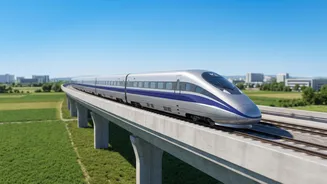
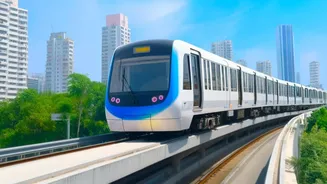
The backbone of the bullet train corridor is the vast network of elevated viaducts. As of mid-2026, the progress has been significant, particularly in Gujarat, where land acquisition moved faster. Across the entire corridor, hundreds of kilometres of pier work and viaduct girder launching are complete. Specifically, reports from August 2026 noted that pier work had crossed the 450 km mark, with over 350 km of viaducts already constructed. In Maharashtra, after initial delays, construction has gained rapid momentum. Work on a 135 km elevated stretch is well underway, with a significant portion of pier construction finished and several mountain tunnels achieving breakthrough. These elevated structures are crucial as they allow the high-speed line to pass over existing infrastructure and farmland with minimal disruption.
Conquering Complex Terrain: Bridges and Tunnels
The project involves monumental engineering challenges, none more so than its bridges and tunnels. Seventeen river bridges were reported as complete by August 2026. In Maharashtra, the most formidable task is the 21 km underground tunnel between BKC and Shilphata, which includes India's first undersea rail tunnel. This 7 km section runs beneath Thane Creek. To accomplish this, massive Tunnel Boring Machines (TBMs), with cutterheads the size of a four-storey building, began excavation in July 2026. These machines are working simultaneously from different points to carve out the single tube that will carry twin tracks, a critical step to connecting the corridor to its Mumbai terminus.
Laying the Tracks for 320 KMPH
With the civil structures taking shape, the focus is increasingly shifting to track and systems integration. The project uses the Japanese Shinkansen's 'J-Slab' ballastless track system, a first for India. By August 2026, over 200 km of the RC track bed had been laid, alongside the installation of thousands of masts for the overhead electrical equipment (OHE) that will power the trains. The laying of track slabs and associated works are progressing in key sections, especially around Surat, Bilimora, and Bharuch, readying the ground for the 2027 trial. Simultaneously, noise barriers are being installed along hundreds of kilometres of the alignment to mitigate the sound from trains travelling at an operational speed of 320 kmph.
The Brains of the Operation: Rolling Stock and Technology
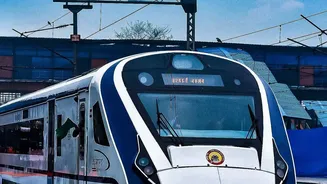
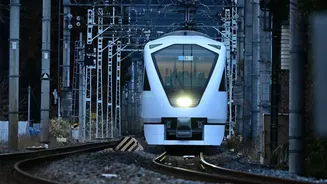
The first services are expected to commence using an indigenously developed Indian high-speed train. BEML is manufacturing the B28 trainset, designed for an operational speed of 250 kmph, with the first prototype expected to be ready for testing in early 2027. This aligns with the timeline for the inaugural run. In the long term, Japan will supply its next-generation E10 Series Shinkansen trains, which are still under development, for deployment in the early 2030s. The entire project is a massive exercise in technology transfer, with Japanese engineers training thousands of Indian counterparts in everything from construction to signalling and safety operations, creating a skilled workforce for India's future high-speed rail ambitions.