


The Line-of-Sight Problem
Historically, communicating with missions on or around the Moon has been a straightforward but limited affair. Spacecraft and ground control talk directly to each other using powerful antennas, a method known as direct-to-Earth communication. This works
well, but it has a major weakness: it requires an unbroken line of sight. If the Moon itself is in the way—as it is for any mission on the far side or for long periods in the treacherous terrain of the lunar south pole—the connection is severed. These predictable blackouts were acceptable for the short Apollo missions but are a non-starter for establishing a sustained human presence. For Artemis astronauts living and working on the Moon, losing contact is not just an inconvenience; it’s a critical safety risk.
Introducing the Lunar Network
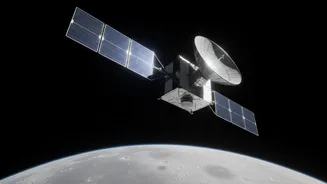
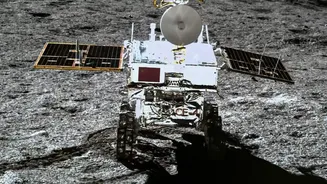
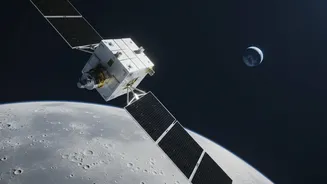
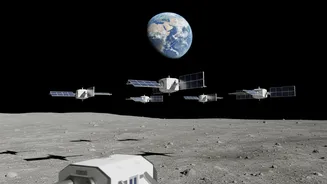
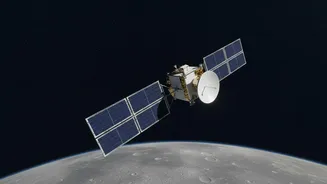
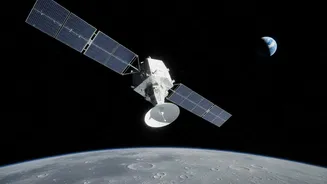
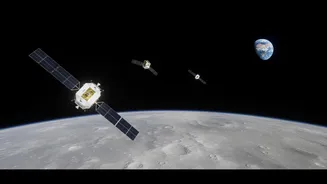
NASA's solution is to stop talking directly at the Moon and start building a network around it. The plan, often referred to as LunaNet, involves deploying a series of satellites into lunar orbit to act as communication and navigation relays. Think of it like the system of cell towers and Wi-Fi routers we use on Earth. Instead of every lunar asset—be it an astronaut, a rover, or a scientific instrument—needing a direct line to Earth, it just needs to connect to the nearest relay satellite. That satellite then routes the signal to its destination, either to another asset on the Moon or back to mission control on Earth. This creates a flexible, robust network that can cover the entire Moon, including the far side and the strategically important but hard-to-reach polar regions.
Unlocking the Lunar South Pole
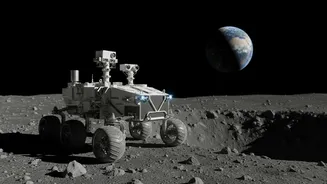
The Artemis program has its sights set on the lunar south pole, a region believed to hold vast quantities of water ice in permanently shadowed craters. This ice could be a game-changer, providing drinking water, breathable air, and rocket propellant. However, the south pole's extreme terrain of deep craters and high ridges makes direct communication with Earth incredibly challenging. Earth appears very low on the horizon, and the line of sight is frequently blocked. A lunar relay network solves this problem. Satellites orbiting the Moon can maintain a constant view of both the surface assets below and the Earth beyond, providing uninterrupted data flow. This continuous contact is essential for navigating rovers, managing habitats, and ensuring astronaut safety during complex surface operations.
More Than Just Talk: A Lunar GPS
The benefits of this network extend far beyond just communication. The system is being designed to provide Position, Navigation, and Timing (PNT) services—essentially, a GPS for the Moon. Currently, determining a precise location on the lunar surface is a difficult process that relies heavily on Earth-based tracking. The LunaNet architecture will allow spacecraft, rovers, and even individual astronauts to know their exact position and velocity in real-time, autonomously, without needing to check in with Earth. This capability is crucial for precision landings, safe rover navigation across treacherous landscapes, and coordinating the work of multiple robotic and human explorers.
A New Commercial Frontier
Instead of building and operating this entire infrastructure by itself, NASA is acting as an anchor customer, partnering with commercial companies to provide these services. Companies like Intuitive Machines have been contracted to develop and launch the first relay satellites, which will form the initial backbone of this lunar network. This approach is designed to foster a new cislunar economy, where private industry can offer communication and navigation services to future commercial and international missions, not just NASA's. By outsourcing the infrastructure, NASA can focus on its primary goal of exploration and scientific discovery, while helping to create a self-sustaining ecosystem of commercial activity around the Moon. This public-private partnership is a foundational element for turning the dream of a permanent lunar base into a reality.