





The Ultimate Packing Problem
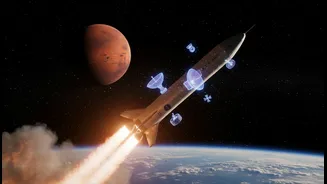
Imagine packing for a trip that lasts nearly two years, where there are no shops and no chance of a delivery. That's the challenge facing planners of future missions to Mars. For short trips to the International Space Station (ISS), astronauts can rely
on regular cargo resupply missions from Earth. But for a journey to another planet, every single kilogram of supplies — from food and water to oxygen tanks — must be launched from Earth, a process that is incredibly expensive and limited by rocket capacity. The traditional approach of stowing all consumables is simply not practical for long-duration spaceflight. This massive logistical hurdle has become one of the most significant barriers to sending humans to Mars and beyond. Solving it requires a fundamental shift in thinking: from carrying everything you need, to creating it along the way.
A New Breed of Astronaut
Enter Dr. Anil Menon, a NASA astronaut of Indian heritage with a uniquely suited background to tackle this challenge. Before being selected as an astronaut, Menon was SpaceX's first flight surgeon, helping to launch the company's first human spaceflights. His resume combines emergency medicine, a thesis on medical kits for commercial spaceflight, and experience as a flight surgeon for ISS expeditions. This blend of medical and engineering expertise places him at the nexus of human health and the harsh realities of space travel. Now an astronaut himself, Menon is part of a generation of spacefarers who are not just pilots and passengers, but active participants in developing the technologies that will sustain future explorers. His work, both on the ground and now in orbit, directly contributes to solving the puzzle of human self-sufficiency far from Earth.
The Living Life Support System
The most promising solution to the space-pantry problem is known as a Bioregenerative Life Support System (BLSS). The concept sounds like science fiction: creating a miniature, self-sustaining ecosystem inside a spacecraft or planetary habitat. Instead of relying on finite, pre-packaged supplies, a BLSS uses biological processes to continuously recycle waste and regenerate life's necessities. At the heart of this concept are living organisms, primarily plants and microalgae. These systems would see astronauts growing their own food, with the plants simultaneously absorbing the carbon dioxide they exhale and releasing fresh oxygen through photosynthesis. Water from sweat, humidity, and even urine would be purified and recycled, creating a nearly closed loop where nothing is wasted. This approach not only dramatically reduces the mass that needs to be launched but also provides a vital layer of safety and redundancy for crews millions of kilometres from home.
From Waste to Wonder with Algae
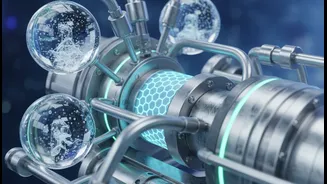
While growing crops like lettuce and tomatoes is part of the plan, some of the most efficient workhorses in a BLSS are microscopic. Researchers are intensely focused on harnessing the power of microalgae, such as Chlorella vulgaris, in devices called photobioreactors. These algae are incredibly efficient at photosynthesis. A bioreactor can cultivate these tiny green organisms to continuously scrub carbon dioxide from the cabin air and produce a steady supply of oxygen. But the benefits don't stop there. This rapidly growing algae also creates a nutrient-rich biomass that is edible. This protein-packed green sludge could become a vital food supplement for astronauts, providing essential amino acids, vitamins, and minerals. Experiments with these bioreactors have already been conducted aboard the ISS, proving that the technology is a viable and powerful component of future life support systems.
Medicine Made in Microgravity
Beyond food and air, medical emergencies pose a significant risk on long missions. Packing a full hospital is impossible, as the space for medical supplies is severely limited. This is where research directly involving experts like Menon becomes critical. One area of study is the in-space production of essential medical supplies, such as intravenous (IV) fluids. An experiment planned for the ISS aims to develop technology that can produce sterile IV bags using the station's existing supply of purified water. Success in this area would be revolutionary, eliminating the need to launch heavy bags of saline and providing a life-saving capability for treating dehydration or injury during deep space missions. It's a perfect example of the broader principle: for humanity to thrive in space, we must learn to live off the land, even when that land is a metal habitat hurtling toward Mars.