




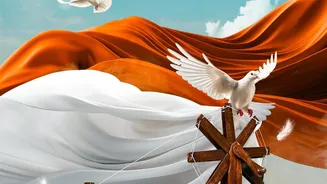
The Date Was Chosen for a Personal Reason
The choice of August 15 was made by Lord Mountbatten, the last Viceroy of India. The British Parliament had given him a mandate to transfer power by June 1948, but escalating violence prompted him to advance the date. He personally chose August 15 because
it marked the second anniversary of Japan's surrender in World War II, a moment of triumph for him as the Supreme Allied Commander in South East Asia.
Gandhiji Was Not Part of the Celebrations
While Delhi celebrated, Mahatma Gandhi, the architect of the freedom movement, was in Calcutta (now Kolkata). He spent the day fasting and praying in an attempt to quell the horrific communal riots that had erupted between Hindus and Muslims following the announcement of Partition. For him, the division of India was a cause for deep anguish, not celebration.
India Had No Official National Anthem
On August 15, 1947, India did not have an official national anthem. While Rabindranath Tagore's 'Jana Gana Mana' was well-known and even sung at the conclusion of the Constituent Assembly session, it was only formally adopted as the national anthem on January 24, 1950. 'Vande Mataram' was also given equal status as a national song due to its role in the freedom struggle.
The Famous Red Fort Ceremony Happened a Day Later
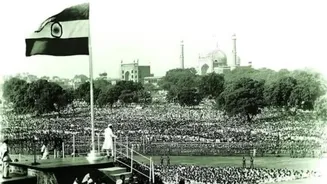
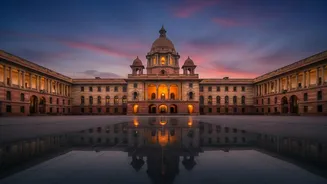
The iconic tradition of the Prime Minister hoisting the national flag at the Red Fort did not begin on August 15, 1947. Jawaharlal Nehru, India's first Prime Minister, raised the flag above the Lahori Gate of the Red Fort on August 16, 1947. The main events on the 15th included the swearing-in ceremony at the Viceroy's House (now Rashtrapati Bhavan) and a public flag hoisting at Princess Park near India Gate.
The 'Tryst with Destiny' Speech Was at Midnight
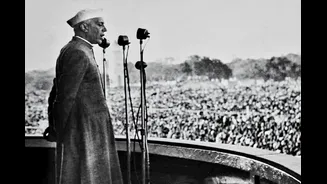
Jawaharlal Nehru’s famous 'Tryst with Destiny' speech was delivered to the Constituent Assembly in New Delhi late on the night of August 14, 1947, just as India was transitioning to freedom at the stroke of midnight. It was a momentous address that eloquently captured the soul of a nation awakening to life and freedom after centuries of colonial rule.
The Borders Were Announced After Independence
While India and Pakistan became independent on August 15 and 14 respectively, the final border, known as the Radcliffe Line, was only officially published on August 17, 1947. This meant that for two days, millions of people in Punjab and Bengal celebrated independence without knowing which country they belonged to, adding to the chaos and violence of the Partition.
India Became a 'Dominion,' Not a Republic
On August 15, 1947, India became an independent Dominion within the British Commonwealth, not a republic. This meant that King George VI was still the head of state, represented by the Governor-General. India only became a full republic on January 26, 1950, when the Constitution of India came into effect and Dr. Rajendra Prasad was elected as the first President.
The Last Viceroy Became the First Governor-General
Lord Mountbatten, the man who oversaw the end of the British Raj as the last Viceroy, was invited by Jawaharlal Nehru to stay on as the first Governor-General of the newly independent Dominion of India. He served in this role until June 1948, playing a key part in the early days of the administration and the integration of princely states.
Hundreds of Princely States Weren't Part of India
At independence, over 560 princely states were not technically part of British India and were given the choice to join either India or Pakistan, or remain independent. The mammoth task of integrating these states fell to Sardar Vallabhbhai Patel, India's first Deputy Prime Minister and Home Minister. Through skilled diplomacy and firm action, most states were successfully integrated, but it was a complex process that unfolded in the months following independence.
The National Flag Was Adopted Just Weeks Before
The Indian tricolour in its current form was officially adopted by the Constituent Assembly on July 22, 1947, just 24 days before independence. The flag, designed by Pingali Venkayya, evolved from several versions used during the freedom struggle. Its formal adoption so close to Independence Day marked a crucial step in defining the visual identity of the new nation.