



An Ocean in the Mountains
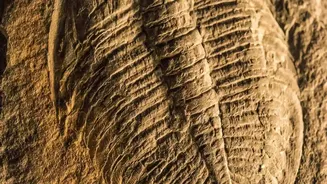
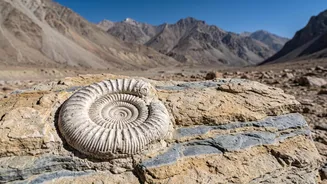
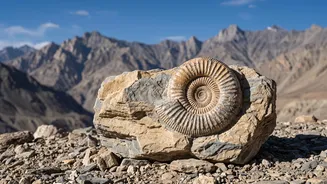
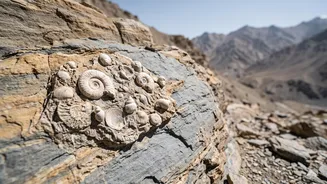
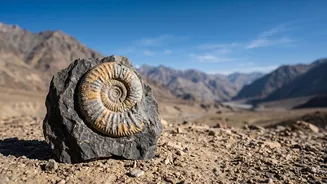
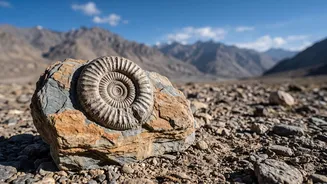
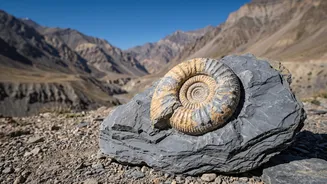
Geologist Dr. Ritesh Arya, founder of the Tethys Fossil Museum, recently announced the discovery of a significant collection of Eocene marine fossils in the Nyoma area of Ladakh's Changthang region. The find includes gastropods (snail-like creatures),
bivalves, and oyster-like forms, all creatures of the sea. Finding such fossils is not entirely new in the Himalayas; the mountain range is famously known to have risen from the ancient Tethys Sea. However, this particular discovery is exciting because of its location and the specific age of the fossils, which are preliminarily dated to be between 34 and 38 million years old. Dr. Arya noted the immediate resemblance of these fossils to those found in the well-studied Subathu Formation in Himachal Pradesh, but finding them so far east in Ladakh was the real surprise.
A Story of Colliding Continents
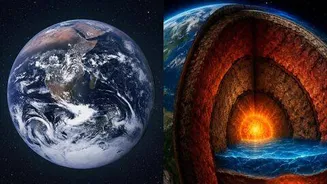
The presence of marine life in what is now a cold desert thousands of metres above sea level tells a dramatic geological story. It is widely accepted that the Himalayan mountains were formed when the Indian tectonic plate, drifting northwards, collided with the much larger Eurasian plate. This colossal collision, which began around 50-55 million years ago, buckled the earth's crust and thrust the seabed of the ancient Tethys Ocean upwards. Over millions of years, this process created the towering peaks we see today. Fossils found on Mount Everest itself serve as a powerful testament to this history. The Ladakh discovery adds another piece to this grand puzzle, potentially extending the known reach of this ancient marine environment further east than previously thought.
Why 38 Million Years Is Significant
The estimated age of these fossils places them squarely in the Eocene Epoch (56 to 33.9 million years ago). This was a critical period in the formation of the Himalayas. During the Eocene, global climates were warm and humid, and the collision between the Indian and Eurasian plates was actively underway. Pinpointing fossils to this era helps scientists reconstruct the paleo-environment—what the region was actually like at that specific time. The combination of marine shells with other reported finds like fossil palms and wood in the wider region suggests a landscape vastly different from today's Ladakh: a warm, coastal area influenced by a shallow sea.
From Discovery to Scientific Fact
As the headline suggests, it is crucial to approach this news with scientific rigour, not just hype. A preliminary identification, even by an experienced geologist, is the first step in a long process. The specimens will now undergo detailed study. Scientists use several methods for confirmation. Relative dating involves comparing the rock layers where the fossils were found to other known layers. Absolute dating provides a more precise numerical age and is often done by analysing radioactive elements in adjacent volcanic rock layers. Geochronologists can measure the decay of isotopes like potassium-40 into argon-40 in volcanic ash to act as a geological clock. The fossils themselves will also be studied to confirm their species (taxonomy) and their position in the geological layers (stratigraphy).
Patience Is a Scientific Virtue
The caution from the scientific community is not about doubting the discovery, but about ensuring its accuracy. Confirmation is essential to solidify what this find means for the geological map of the Himalayas. If the link to the Subathu sea is confirmed, it could reshape the understanding of the region's geography during the Eocene. Dr. Arya himself first presented evidence of marine fossils from Nyoma in 2018 at a conference by the Wadia Institute of Himalayan Geology, and this new, larger collection allows for much more detailed analysis. Eminent palaeontologist Professor Ashok Sahni has praised the discovery, noting it is on par with other significant finds. This highlights the potential importance of the fossils while underscoring that the work of formal verification is just beginning.