





A Natural Head Start
India's service sectors, including its world-renowned IT and Business Process Outsourcing (BPO) industries, have a massive head start in the AI race. These sectors are built on digital foundations, generate vast amounts of data, and employ millions of tech-savvy
professionals. Unlike physical industries that require retrofitting factories or fields, the service economy operates on code, communication, and data—the very fuel of modern AI. This inherent digital maturity means they can integrate AI solutions like machine learning models, chatbots, and predictive analytics directly into existing workflows with far less friction and capital expenditure. The result is a natural advantage, allowing them to experiment, iterate, and scale AI-driven innovations much quicker than their counterparts in manufacturing or agriculture.
What Do 'AI Gains' Look Like?
The benefits of AI in the service sector go far beyond automating simple tasks. For India's IT giants and burgeoning startups, Generative AI is a massive productivity multiplier. It's accelerating software development, creating content, and transforming customer support. In the financial services industry, AI is revolutionizing risk assessment, fraud detection, and personalized banking. The BPO sector is moving from call centers to AI-powered command centers, where human agents handle complex, high-value interactions while AI manages routine queries. This shift leads to dramatic efficiency gains, with some reports citing improvements of 15-35% in specific tasks. This isn't about cutting costs; it's about creating new, higher-value services and moving up the global value chain.
The Physical World's Hurdles
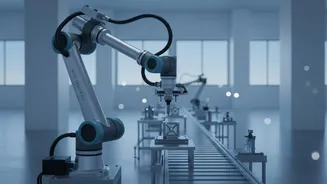
While the service sector sprints ahead, physical industries like manufacturing and agriculture face a steeper climb. AI adoption here is often slower and more complex. For manufacturers, integrating AI can mean overhauling entire production lines with smart sensors and robotics, a capital-intensive process. Many small and medium-sized enterprises (MSMEs), which form the backbone of Indian manufacturing, lack the necessary capital, digital infrastructure, and skilled talent to implement these changes. Similarly, in agriculture, challenges include fragmented landholdings, poor rural internet connectivity, and low digital literacy among farmers. While AI holds immense promise for precision farming and optimizing supply chains, these structural barriers significantly slow down its widespread adoption.
Reskilling for an AI-Powered Future
The rapid adoption of AI in the service economy is also driving a massive push for workforce transformation. According to NASSCOM, over 2 million IT professionals were upskilled in AI in fiscal year 2026 alone. The focus is shifting from routine operational roles to more specialized, knowledge-intensive functions that combine domain expertise with AI proficiency. This isn't about replacement but evolution, creating a new 'Human + AI' working model. Roles are becoming more hybrid, requiring a blend of traditional skills with data analysis and AI tool literacy. While concerns about job displacement are valid, the trend within the service sector points more towards role redesign and an expansion of the opportunity frontier for those willing to adapt.
Closing the AI Divide
The divergence in AI adoption rates presents a crucial challenge for India. For the nation to fully realize the estimated economic boost from AI—potentially adding over $950 billion to the GDP by 2030—the gains must be broad-based. Government initiatives like the IndiaAI Mission, with its focus on building computing infrastructure and fostering innovation, are a vital step. However, translating this to the ground level in physical industries will require targeted policies. This includes subsidizing AI tools for MSMEs and farmers, investing in rural digital literacy, and creating region-specific AI models that can work in diverse local contexts. The goal is not just to let the service sector win the race, but to ensure all sectors can participate in the AI-driven transformation of India's economy.