






Beyond Spheres and Simple Physics
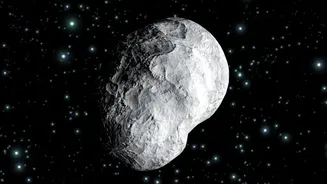
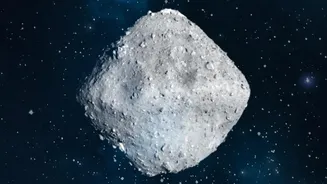
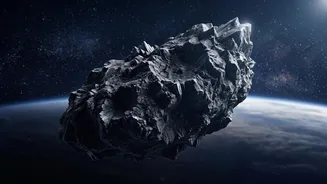
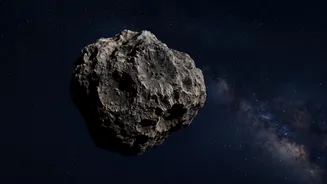
For years, planning for planetary defense involved a necessary simplification: modeling asteroids as simple, solid spheres. This made the incredibly complex calculations of a potential impact more manageable. However, real asteroids are not smooth, uniform
spheres. They are often lumpy, irregular bodies covered in ridges, craters, and loose rubble. Recognizing this, researchers at Sandia National Laboratories developed a new, more sophisticated computer model to simulate how these non-spherical asteroids would react to a deflection attempt. This new approach is over 1,600 times faster than previous methods, finally allowing scientists to combine realistic, complex asteroid shapes with high-fidelity physics to get a much clearer picture of what might happen.
Why Shape Changes Everything
The latest research focuses on a 'stand-off' nuclear deflection method, where a nuclear device is detonated near an asteroid. The blast of X-ray radiation would instantly vaporize a layer of the asteroid's surface, creating a powerful jet of escaping material that acts like a rocket thruster, pushing the asteroid onto a new path. The new simulations show that the effectiveness of this push depends entirely on the surface it hits. A flat surface gets a clean, efficient push. But if the blast hits the side of a crater or a steep ridge, the escaping vapor shoots off at an angle, delivering far less of a nudge in the desired direction. The simulations, published in the journal Icarus, found that for the same asteroid, targeting one side resulted in a deflection velocity of 3.9 millimeters per second, while targeting another side produced a change of only 0.8 millimeters per second — a nearly fivefold difference.
From Kinetic Impacts to Nuclear Pulses
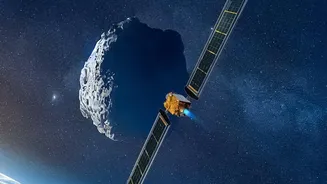
This research builds on lessons from other planetary defense studies, including NASA's successful DART (Double Asteroid Redirection Test) mission in 2022. The DART mission used a 'kinetic impactor', simply crashing a spacecraft into an asteroid to change its course. A key finding from DART was the importance of 'momentum enhancement' — the extra push provided by the tons of rock and dust blasted from the impact crater. This showed that an asteroid's internal structure, such as its porosity or whether it's a solid rock versus a loose 'rubble pile', dramatically affects the outcome. The new models for nuclear deflection add another layer of complexity, showing that even beyond the internal makeup, the external topography is a critical factor that must be considered for any future mission.
A Complicated Future for Planetary Defense
These findings present a significant challenge for planetary defense planners. To effectively deflect a threatening asteroid, we would first need to know its exact shape in high-resolution 3D. This would require sending a reconnaissance mission to the object long before a deflector is launched. The new simulations also showed that the asteroid's rotation could be drastically altered, with the spin rate changing by as much as a factor of 17 depending on the blast angle. An uncontrolled tumble could make a followup mission much more difficult. Furthermore, the model cannot yet reliably predict if the entire asteroid would fracture from the blast, a disastrous outcome that could turn a single threat into a shotgun blast of smaller, but still dangerous, fragments.