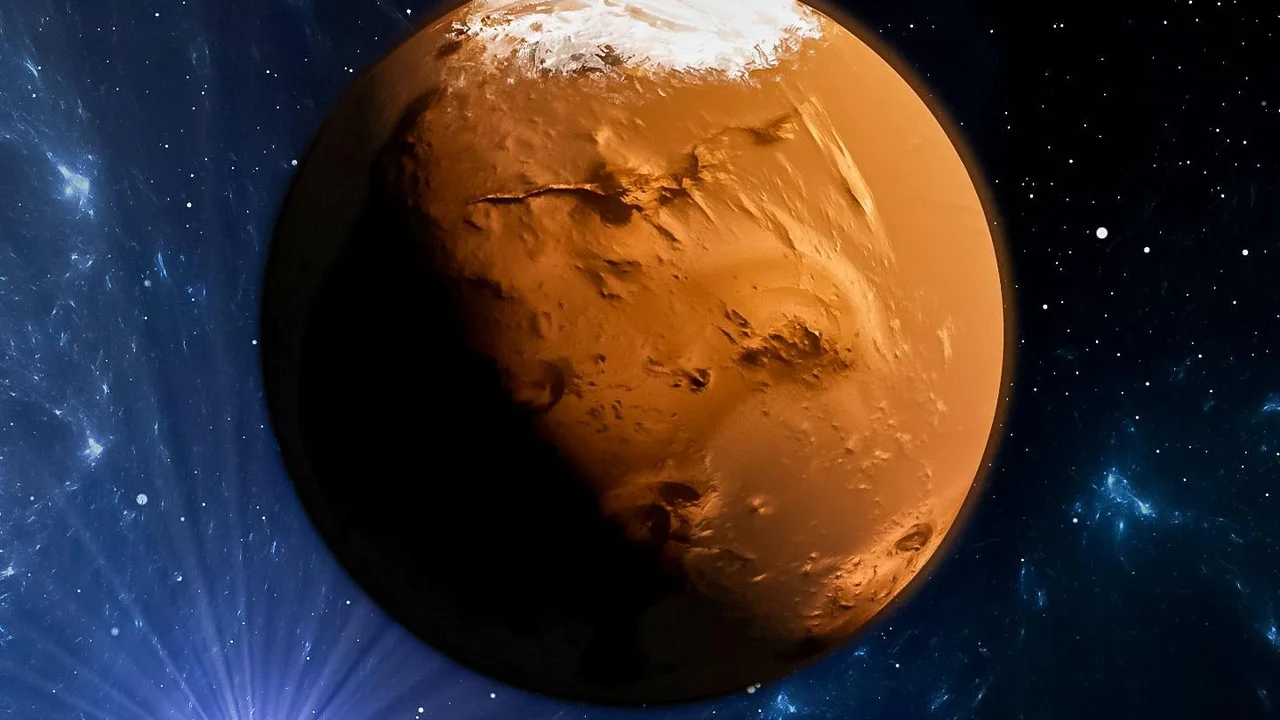








A Planet of Extremes
Researchers from the Physical Research Laboratory (PRL) in Ahmedabad have revealed the sheer scale of temperature changes on the Martian surface. Their study, focusing on two of the planet's largest impact basins, Hellas and Argyre, recorded temperatures
ranging from a surprisingly mild 27 degrees Celsius in the summer down to a brutal minus 113 degrees Celsius in winter. These findings highlight a climate far more dynamic than previously modeled. This enormous fluctuation is primarily due to Mars's incredibly thin atmosphere, which is about 100 times less dense than Earth's. Without a thick atmospheric blanket to trap and circulate heat, the Martian surface warms up quickly under the sun and loses that heat just as fast when night falls.
A Tale of Two Basins
The choice of the Hellas and Argyre basins was strategic. These aren't just any craters; they are colossal impact sites in Mars's southern hemisphere. Hellas Planitia is one of the largest and deepest impact basins in the solar system, with its floor lying over 7,000 meters below the standard Martian elevation. This immense depth means the atmospheric pressure at the bottom is significantly higher, creating a unique micro-environment. The PRL scientists discovered that the extreme topography of these basins has a profound effect on the planet's atmospheric patterns. The temperature changes don't just happen uniformly; they move in large-scale waves, influenced by the deep craters and surrounding highlands.
The Science of the Seasons
The study also sheds light on Mars's dramatic seasonal imbalances. Mars has a much more elliptical, or oval-shaped, orbit than Earth. It swings significantly closer to the Sun during its southern hemisphere's summer, making that season far more intense than its northern counterpart. The research from the PRL team quantified this, noting that temperatures in the southern regions during their summer were about 25 Kelvin (25 degrees Celsius) higher than in the north during its summer. This intense, uneven heating, combined with the unique topography of the Hellas and Argyre basins, drives the complex atmospheric waves the scientists observed.
India's Martian Legacy
This research is the latest achievement in India's long-standing commitment to Martian exploration. While the famed Mars Orbiter Mission (Mangalyaan) has concluded, Indian scientists continue to be at the forefront of planetary science. For this study, the PRL team, which included S. A. Haider and Dimitra Atri, used data from the Emirates Mars Infrared Spectrometer (EMIRS) aboard the UAE's Hope spacecraft. This collaborative approach demonstrates a modern, interconnected scientific community working to unravel the mysteries of our solar system. The findings are not just academic; they have crucial real-world applications for understanding the Red Planet's history and planning for the future.
Improving Models and Future Missions
One of the most significant outcomes of this study is its ability to refine our climate models of Mars. The researchers found that the existing Mars Climate Database often predicted temperatures about 10 Kelvin cooler than what was actually observed by the Hope spacecraft. By identifying these discrepancies, scientists can now recalibrate their models to more accurately predict weather patterns, seasonal changes, and long-term climate evolution. This enhanced accuracy is vital for future missions to Mars, both robotic and crewed. Knowing the precise thermal conditions on the surface is essential for designing equipment, ensuring the safety of landers, and identifying potential resources or hazards.