





A Leap Towards a Home in Space
In a significant announcement that underscores India's growing aerospace capabilities, ISRO has confirmed the development of crucial technologies for spacecraft docking. This achievement is not just a technical victory; it is the foundational piece required
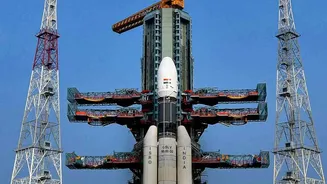
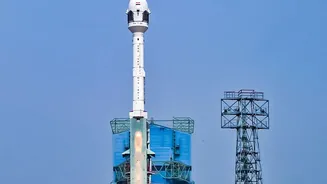
for the assembly of the proposed Bharatiya Antariksha Station (BAS). The government has stated that the baseline design review for the station's first module (BAS-01) is complete, with subsystem design now underway. This progress is a direct result of technologies pioneered for the Gaganyaan human spaceflight programme and demonstrated through precursor missions like the Space Docking Experiment (SpaDeX). The SpaDeX mission, which successfully performed a docking operation in early 2025, made India only the fourth country in the world—after the US, Russia, and China—to master this complex manoeuvre in space.
The Cosmic Handshake Explained
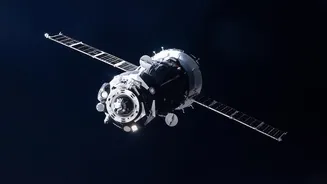
So, what exactly is docking? Imagine trying to thread a needle while both you and the needle are moving at over 27,000 kilometres per hour in zero gravity. That's the essence of space docking. It's the process of joining two separate spacecraft together in orbit to form a single, connected structure. This cosmic handshake must be incredibly precise, creating a pressurised and structurally sound seal that allows for the transfer of crew, cargo, power, and data between the two vehicles. The procedure typically involves a 'chaser' spacecraft actively manoeuvring towards a 'target'. The final moments involve a 'soft capture' to align the vehicles, followed by a 'hard capture' where multiple latches engage to create a rigid, airtight connection. Mastering this is non-negotiable for building a modular space station, which is assembled piece by piece in orbit.
India’s Indigenous Docking Systems
Rather than relying on a single solution, ISRO has developed its own androgynous, low-impact system, proving its self-reliance in this critical domain. The technology was tested with the SpaDeX mission, which used two identical spacecraft, meaning either one could function as the chaser or the target. This system, known as the Bhartiya Docking System (BDS), was developed after attempts to import the technology from other nations proved unsuccessful. It is conceptually similar to the International Docking System Standard (IDSS) but is a more streamlined design. For building the Bharatiya Antariksha Station, ISRO is working on multiple interfaces. One is a system similar to the Russian SSVP (Sistema Stykovki i Vnutrennego Perekhoda), a probe-and-drogue mechanism historically used for connecting crewed Soyuz capsules to space stations. Another is a larger berthing mechanism for connecting the station's main modules.
The Grand Vision: Bharatiya Antariksha Station
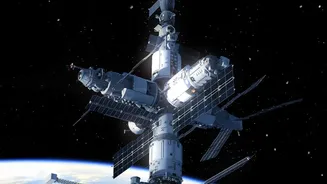
This docking capability is the key that unlocks ISRO's grand vision for a permanent address in low-Earth orbit. The Bharatiya Antariksha Station is planned as a five-module, 52-tonne facility orbiting at an altitude of about 400-450 km. According to the current timeline, ISRO aims to launch the first module, BAS-01, by 2028. This initial module will serve as a base for future expansion, housing crew quarters and life support systems. The complete five-module station, including a core docking module and dedicated science labs, is projected to be fully operational by 2035. The BAS will enable Indian astronauts to conduct long-duration stays in space for three to six months, performing advanced research in microgravity and positioning India as a major player in global space exploration.