





A Land of Dramatic Contrasts
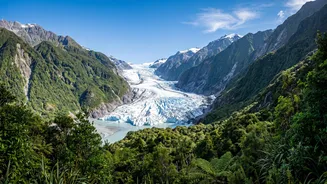
Imagine standing amidst ferns and ancient trees, the air thick with the smell of damp earth, while gazing up at a brilliant white and blue glacier carving its path down a mountain valley. This is the reality in Westland Tai Poutini National Park, a UNESCO
World Heritage site. Here, the Franz Josef and Fox Glaciers terminate at an incredibly low altitude—less than 300 meters above sea level—placing their icy tongues in the same neighbourhood as a temperate rainforest. This sharp juxtaposition of alpine ice and verdant forest is a rare spectacle, found in only a few places on Earth.
The Key Ingredient: Massive Snowfall
The first part of the explanation lies high in the mountains. The Southern Alps form a formidable barrier running down the spine of the South Island. Moist air, carried from the Tasman Sea, is forced to rise dramatically as it hits this mountain range—a process known as orographic lift. As the air climbs, it cools, and its moisture condenses into clouds, resulting in immense amounts of precipitation. In the upper reaches of the Alps, this precipitation falls as snow, with some areas receiving up to 30 meters each year. This phenomenal snowfall constantly feeds the glaciers' accumulation zones, creating an enormous reservoir of ice.
An Alpine Superhighway to the Forest
Having all that ice is one thing, but getting it down to the rainforest is another. The valleys carved by Franz Josef and Fox are exceptionally steep and relatively short. This creates a perfect chute for the ice to flow downwards at a remarkable pace. While many glaciers move imperceptibly, Franz Josef and Fox are among the fastest-moving in the world, advancing by several meters per day in some sections. This rapid movement means the ice can travel from the high-altitude snowfields to the low-altitude rainforest valley before it has a chance to melt completely, acting like a frozen conveyor belt.
A Story Written in Tears
Beyond the geology, the glaciers hold deep cultural significance for the local Māori, Ngāi Tahu. The traditional name for Franz Josef Glacier is Kā Roimata o Hine Hukatere, which translates to 'The tears of Hine Hukatere'. Legend tells of a fearless mountain climber, Hine Hukatere, who persuaded her love, Wawe, to climb with her. Wawe was less experienced and was tragically killed in an avalanche. Heartbroken, Hine Hukatere wept, and her tears flowed down the mountain, where the gods froze them to create the glacier as a perpetual memorial to her grief. The Waiho River, which flows from the glacier, is said to be her tears still flowing.
A Fragile and Retreating Wonder
While these glaciers have advanced and retreated for millennia, the current rate of retreat is unprecedented. Driven by climate change, both Franz Josef and Fox have lost significant length and volume in recent decades. This rapid melt has made the terminal faces unstable and dangerous, meaning that visitors who could once walk right up to the ice now must rely on helicopter tours to get onto the glaciers themselves. The shrinking of these magnificent natural wonders serves as a stark and visible reminder of a warming planet, threatening the very existence of this unique ice-and-rainforest landscape.