



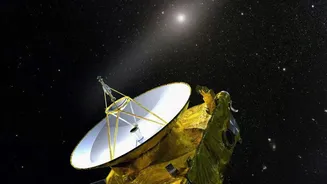


A Telescope Built to See the Invisible
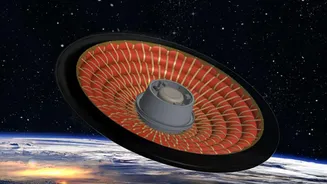
Launched in late 2021, NASA's Imaging X-ray Polarimetry Explorer (IXPE) is not like other telescopes. Instead of just measuring the brightness or colour of light from cosmic objects, IXPE has a unique superpower: it measures the polarization of X-rays.
Think of light waves as vibrating in many different directions. When light becomes polarized, it means all its waves are vibrating in a single, aligned direction, much like how polarized sunglasses work by filtering out glare. By studying the polarization of X-rays—a type of high-energy light produced by the universe’s most extreme events—scientists can piece together the story of where that light came from and what it travelled through. This makes IXPE the perfect tool to investigate some of the most violent and mysterious objects in the cosmos, like black holes and neutron stars.
The Ghostly Prediction from 1936
The story begins in 1936, when physicists Werner Heisenberg and Hans Euler proposed a radical idea rooted in the new and strange world of quantum mechanics. They predicted that under the influence of an incredibly powerful magnetic field, the vacuum of space itself should behave like a crystal. This effect, called “vacuum birefringence,” suggests that a strong magnetic field can cause empty space to develop a preference, splitting a light beam into two and polarizing it. According to quantum electrodynamics (QED), this happens because the vacuum is not empty but is instead fizzing with 'virtual' particles that pop in and out of existence. A super-strong magnetic field can align these fleeting particles, temporarily turning empty space into an optical filter. For decades, this prediction remained purely theoretical, as no magnetic field on Earth could ever be strong enough to test it.
A Cosmic Lighthouse Called a Magnetar
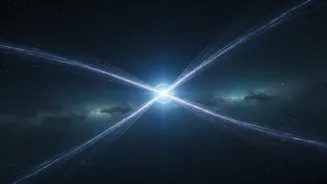
To test the 90-year-old theory, scientists needed a natural laboratory with magnetic fields far beyond anything humans can create. They found it in a magnetar, a special and rare type of neutron star. Neutron stars are the ultra-dense collapsed cores of massive stars, packing more mass than our sun into a sphere the size of a city. Magnetars are the most magnetic objects known in the universe, with fields a trillion times stronger than Earth’s. Researchers pointed IXPE at a magnetar named 1E 1547.0-5408 for over 140 hours between March and April 2025. This particular magnetar was an ideal candidate because it spins rapidly—once every two seconds—and emits steady beams of both X-rays and radio waves, like a cosmic lighthouse.
The Evidence in the Light
When the data came back, the science team found exactly what they were hoping for. The X-rays coming from the magnetar were highly polarized—far more than could be explained by existing models without vacuum birefringence. In some phases of the magnetar’s rotation, the polarization level reached a staggering 80%. According to the researchers, this extremely high level of polarization strongly suggests that the X-ray light was altered as it passed through the magnetar’s intense magnetic field. Models that included the effects of vacuum birefringence matched the observed data much better than models that did not. In essence, IXPE had witnessed the vacuum of space bending light just as Heisenberg and Euler had predicted almost a century ago.
Why This Discovery Matters
While scientists are careful to state that more observations are needed to confirm the result with absolute certainty, this finding is a landmark achievement for physics. It provides the most compelling observational evidence yet for a key, unproven prediction of quantum electrodynamics, one of the most successful theories in science. It demonstrates that the vacuum is a dynamic and complex entity, not a void. This opens up a new way to probe the fundamental laws of nature in environments so extreme they can never be replicated on Earth. By using the cosmos as a laboratory, IXPE is allowing scientists to see the bizarre rules of the quantum world play out on a galactic scale, deepening our understanding of the universe's most fundamental properties.