






The Players and the Prize
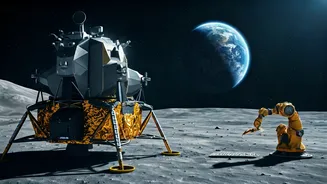
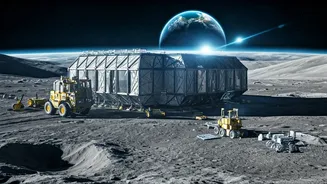
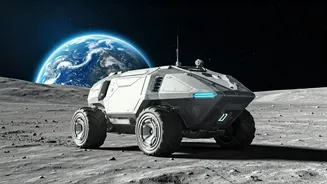
NASA recently announced it has awarded new contracts totaling nearly $600 million to accelerate its "Moon Base" program. The funds are being distributed among three American commercial space companies: Astrobotic, Firefly Aerospace, and Intuitive Machines.
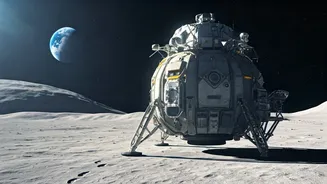
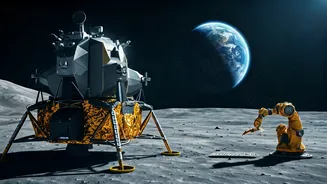
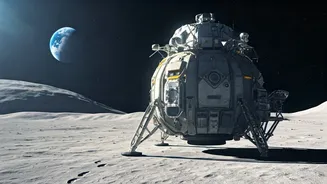
Pittsburgh-based Astrobotic is the biggest winner, securing approximately $297.9 million for two lunar delivery missions. Firefly Aerospace of Texas and Intuitive Machines of Houston received about $144.2 million and $148.3 million respectively, each for one mission. These contracts are part of NASA's Commercial Lunar Payload Services (CLPS) initiative, which is the backbone of its strategy to create a sustainable, long-term human presence on the Moon. Instead of building its own vehicles, NASA is paying these companies to transport science and technology payloads to the lunar surface, effectively kickstarting a commercial delivery service for the Moon.
Building Blocks for a Lunar Future
So, what will this nearly $600 million actually buy? The funding is for four robotic landing missions scheduled for late 2028. Each mission will deliver a suite of crucial NASA instruments to the Moon. These aren't just random science experiments; they are foundational technologies needed to build and operate a future base. Payloads include a stereo camera system to study how rocket plumes interact with lunar dust—a critical detail for safe and frequent landings. Another key instrument is a laser retroreflector array, which will act as a permanent navigation marker on the Moon, helping future spacecraft land with pinpoint accuracy. Finally, a spectrometer will measure the radiation environment on the surface, providing essential data for designing habitats that can keep future astronauts safe. These robotic missions are the advance scouts, gathering the data needed before humans arrive to stay.
A New, Commercially-Driven Space Race
This investment highlights a major shift in NASA's strategy. Rather than a government-led Apollo-style program, the return to the Moon is being framed as a public-private partnership. NASA is deliberately fostering a competitive marketplace of commercial providers. By awarding contracts to multiple companies, the agency increases its mission frequency and encourages innovation as these firms refine their lander designs. Many of the companies are using updated versions of landers that have already flown, which helps speed up the timeline and reduce risk. This approach is designed to create a robust lunar economy, where NASA is just one of many customers. It's a model that has worked for sending cargo and crew to the International Space Station and is now being applied to our nearest celestial neighbor, with the ultimate goal of establishing the first human outpost on another world.
Why This Matters for Earth and Beyond
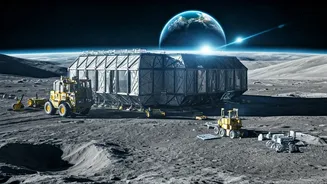
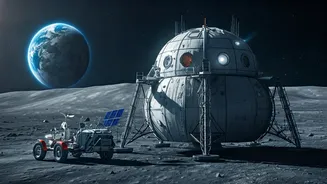
Establishing a permanent base on the Moon isn't just about planting a flag. It's a critical stepping stone for humanity's future in space. The Moon is seen as a vital proving ground for technologies and strategies needed for the even more ambitious goal of sending humans to Mars. The focus on the lunar south pole is strategic; scientists believe the region holds water ice in permanently shadowed craters. This ice could be mined to provide drinking water, breathable air, and even rocket fuel, drastically reducing the cost and complexity of deep space missions. Furthermore, the development of technologies for a lunar base, from advanced robotics and 3D printing with lunar soil to new power systems, could have significant spin-off benefits for industries back on Earth. This $600 million lift is not just an investment in space, but an investment in future technology and exploration.