



An Accidental Bullseye
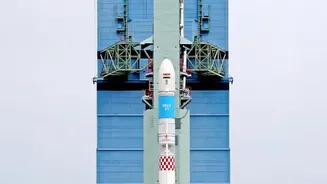
On August 5, 2026, a man-made object weighing nearly four tonnes ended its journey by crashing into the Moon at over 8,700 kilometres per hour. The object was the upper stage of a SpaceX Falcon 9 rocket. Launched in January 2025, its primary mission was to deploy
two commercial lunar landers. After completing its task, the rocket stage lacked the fuel to either return to Earth's atmosphere to burn up or move into a stable long-term orbit. It was left to drift in a chaotic path, its trajectory slowly warped by the gravitational pulls of the Sun and Earth until it was set on an irreversible collision course with the Moon. Scientists had predicted the impact, but because it occurred on the sunlit side of the Moon, it was impossible to see from Earth in real-time.
Cosmic Detective Work
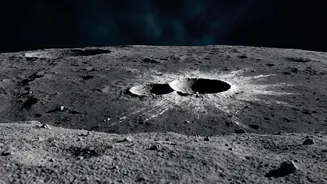
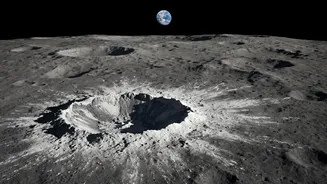
The successful imaging of the aftermath was a feat of global cooperation. Independent astronomers first identified the rocket's trajectory using publicly available data. NASA's Center for Near Earth Object Studies then refined these calculations, confirming a 100% chance of impact. This allowed NASA to task its Lunar Reconnaissance Orbiter (LRO) with a specific mission: find the crater. Between August 11 and 12, the LRO passed over the predicted site and captured a series of before-and-after images, confirming the impact's location near a feature known as Einstein Crater. The resulting images revealed a fresh crater about 60 feet wide and less than 10 feet deep, surrounded by bright and dark streaks of excavated lunar material.
An Unexpected Scientific Clue
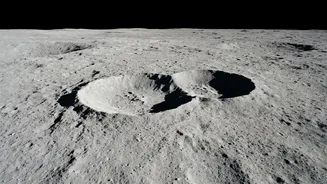
Interestingly, this was not the first time a rocket part had hit the moon, but it produced a unique result. Back in 2022, another rogue rocket body—initially misidentified as a Falcon 9 stage but later attributed to a Chinese mission—crashed and created a surprising double crater. That unusual shape suggested the object had large masses at each end. This latest Falcon 9 impact, however, created a more conventional single crater, which, along with the ejecta patterns, provides valuable scientific data. The collision kicked up material from beneath the Moon's weathered surface, giving scientists a rare, albeit accidental, look at fresher geology without having to land a mission there. Observing these impacts helps researchers understand the physics of high-velocity collisions and refine models of the lunar surface.
The Growing Problem of Space Junk
While a fascinating scientific event, the crash highlights a pressing issue: the unregulated junkyard we are creating in deep space. Earth's orbit is already cluttered with millions of pieces of debris, posing a constant threat to active satellites. Now, that problem is expanding into the cislunar domain—the vast region between Earth and the Moon. Unlike in low-Earth orbit, there is currently no international agreement or robust infrastructure for tracking and managing debris in this farther frontier. As more nations and private companies like SpaceX plan missions to the Moon, the risk of collisions and the accumulation of discarded hardware grows. This impact is a clear signal that the days of treating deep space as an infinite dumping ground are numbered.