
The Planet's Restless Jigsaw Puzzle
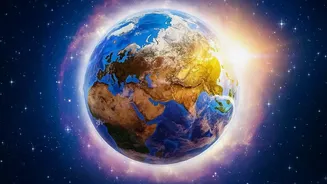
Earth's history is a story of assembly and separation. For billions of years, the planet's tectonic plates have drifted, collided, and pulled apart, driven by slow-moving convection currents in the mantle. This process periodically brings most of Earth's landmass
together into a single, colossal continent. We call these landmasses supercontinents. The most famous of these was Pangea, which existed between about 335 and 175 million years ago. But Pangea was not the first, with geologists identifying earlier supercontinents like Rodinia and Columbia (also known as Nuna). This recurring pattern is known as the supercontinent cycle, which operates on a timescale of roughly 400 to 600 million years. Since Pangea broke apart around 200 million years ago, we are now in the middle of a cycle, meaning the continents are on a long, slow march toward their next reunion.
Introducing the Amasia Hypothesis
So, what will the next supercontinent look like? Scientists have several competing theories, and one of the most prominent is Amasia. The name itself is a giveaway, a portmanteau of America and Asia. The Amasia hypothesis predicts that the Americas will continue their westward drift, eventually colliding with a northbound Australia and a stationary Asia. The engine for this continental mash-up is the slow shrinking of the Pacific Ocean. This vast ocean, a remnant of the superocean that surrounded Pangea, is closing at a rate of about an inch per year as its floor is subducted—or forced underneath—the tectonic plates of Eurasia and the Americas. This process is visible today in the intense volcanic and seismic activity of the Pacific's "Ring of Fire." Supercomputer simulations lend weight to this idea, suggesting that as the Earth has cooled over billions of years, the crust under younger oceans like the Atlantic is stronger, making the older, weaker Pacific Ocean more likely to close.
A Collision at the Top of the World
In the most-cited version of the Amasia scenario, the continents don't just merge, they gather in an entirely new location: the Arctic. The theory suggests that North America and South America will fuse together, while the Arctic Ocean and the Caribbean Sea disappear. The conjoined continents would then drift north to collide with Europe and Asia, creating a massive landmass clustered around the North Pole, with only Antarctica remaining isolated in the south. This formation would occur through a process scientists call "extroversion," where the new supercontinent forms on the opposite side of the globe from where the previous one (Pangea) broke apart. The timeline for this geological spectacle is immense, with most models predicting Amasia's formation between 200 and 300 million years from now.
Not the Only Possibility
While Amasia is a strong contender, it's not the only theory on the drawing board. Scientific predictions this far into the future are inherently speculative, and other models propose different outcomes. One alternative is Novopangaea or Pangea Proxima, which follows an "introversion" model. In this scenario, the Atlantic Ocean, which is currently widening, would eventually begin to shrink, pulling the Americas back toward Africa and Europe to reform a landmass near the site of the original Pangea. Another hypothesis is Aurica, where both the Atlantic and Pacific oceans close simultaneously, causing the continents to gather around the equator. Each scenario—Amasia, Pangea Proxima, or Aurica—would create a dramatically different world with its own unique climate and conditions.
A Transformed and Hostile World
Regardless of which supercontinent forms, the world in 250 million years will be almost unrecognizable and likely inhospitable for mammals. The formation of a massive landmass would drastically alter climates, creating vast, arid deserts in the interior, far from the moderating influence of oceans. In the Pangea Proxima model, increased volcanic activity would pump enormous amounts of carbon dioxide into the atmosphere. Combined with a sun that is predicted to be 2.5% brighter, this could lead to extreme global temperatures. An Amasia clustered around the North Pole might create a massive ice sheet, triggering a global cooling effect. While these are fascinating thought experiments, they underscore a profound truth: our planet is a dynamic and ever-changing system, operating on a scale that dwarfs human experience.