






The Cosmic Glue We Can't See
Imagine trying to understand a city when you can only see the streetlights, but not the buildings, roads, or people. That’s the challenge physicists face with the universe. The stars and galaxies we can see are just a fraction of what’s out there. The rest
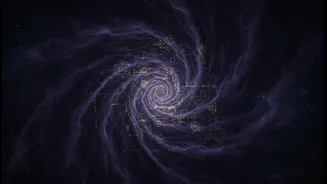
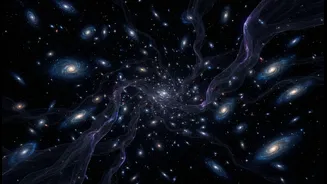
is an invisible substance called dark matter. Scientists are certain it exists because of its immense gravitational pull, which acts like a cosmic glue holding entire galaxies together and preventing them from flying apart. Despite its profound influence, dark matter doesn't emit, reflect, or interact with light, making it completely invisible to all our current instruments. For decades, finding it has been one of the most significant challenges in modern physics, inspiring countless experiments and a fair share of science fiction plotlines.
Searching in an Extra Dimension
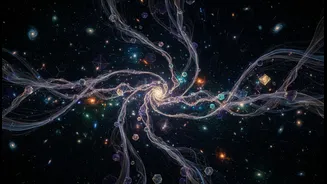
When the familiar rules of physics aren't enough to explain a cosmic mystery, scientists sometimes have to think outside our three-dimensional box. The idea of extra, hidden dimensions isn't just a fantasy trope; it's a concept rooted in advanced theoretical physics, often used to solve deep puzzles about the universe. String theory, for example, proposes multiple tiny, curled-up dimensions. The idea that dark matter might exist in one of these extra dimensions has been explored before. The logic is that if dark matter particles primarily exist and interact in a dimension our normal matter cannot access, it would elegantly explain why they are so hard for us to detect. We can feel their gravity, which ripples across all dimensions, but we can’t ‘touch’ or ‘see’ the particles themselves.
A New Theory of Natural Resonance
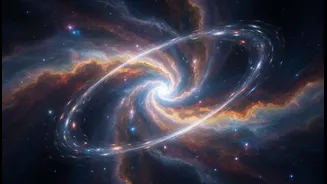
Recently, scientists at the University of Sheffield have taken this idea a step further. In a study published in the journal Physical Review D, they propose a compelling new framework. Their theory suggests that dark matter resides in a hidden fifth dimension along with a force-carrying particle called a 'dark photon'. The truly novel part of their idea is that the specific geometry of this extra dimension naturally causes the masses of these dark particles to align in a precise arrangement. This creates a phenomenon the researchers call 'dark matter resonance', which they compare to how a musical instrument vibrates intensely when it hits just the right note. According to this model, the dimension itself is 'tuned' to make dark matter behave in a very specific way.
Solving a Fine-Tuning Problem
This concept of a natural resonance is a significant breakthrough because it solves a major headache for physicists. Previous models that used resonance to explain dark matter's behaviour required scientists to meticulously 'fine-tune' the particle masses by hand—an artificial step that made the theories feel less convincing. The Sheffield theory proposes that this perfect tuning is not a coincidence but a natural consequence of the hidden dimension’s mathematical structure. This could explain one of dark matter's most puzzling properties: why it seems to have interacted strongly in the chaotic early universe, allowing it to form in the right abundance, yet appears so inert and elusive today. The resonance would have been active in the universe's infancy but faded as the cosmos expanded and cooled.
What This Means for the Search
While this is still a theory, it has powerful implications. By connecting the mystery of dark matter with the existence of hidden dimensions in a new, more natural way, the research provides a fresh roadmap for experimental physicists. According to Dr. Yu-Dai Tsai, one of the study's authors, this work gives scientists “clear new targets in the search for dark matter.” Instead of searching blindly, future experiments could be designed to look for the specific signatures of this resonance or the effects of a dark photon. It provides a more focused direction for the multi-billion dollar global effort to finally identify this elusive component of our cosmos. The search for dark matter has already driven practical advances in sensor technology, computing, and quantum measurement, and this new theoretical path could inspire the next generation of tools.