




The Unassuming Houseplant
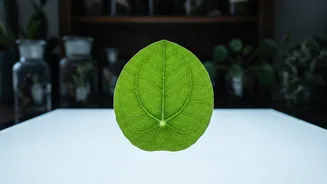
The Chinese Money Plant, or Pilea peperomioides, has become an icon of modern indoor gardening. Its popularity stems from its unique appearance—bright green, perfectly round, pancake-like leaves attached to a central stem—and its reputation as being easy
to care for and propagate. Often called the 'friendship plant' or 'pass-it-on plant', it readily produces small offshoots that can be shared, spreading its charm from one home to another. But while many admire its aesthetic appeal, scientists have recently uncovered a hidden layer of complexity woven into its very structure, turning this common plant into an object of intense scientific curiosity.
What on Earth is a Voronoi Diagram?
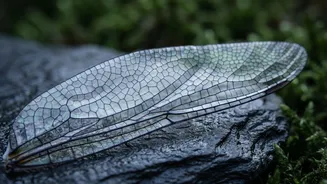
To understand the plant's secret, we first need to talk about geometry. A Voronoi diagram is a way of dividing space. Imagine scattering a handful of points onto a flat surface. Now, for each point, you draw a boundary around it that includes every spot on the surface that is closer to that point than to any other. The result is a pattern of geometric cells that look a bit like a giraffe's coat, dragonfly wings, or foam bubbles. This elegant and efficient pattern isn't just a mathematical curiosity; it's used in everything from city planning to design school districts to designing mobile phone networks to ensure optimal coverage. It’s a fundamental way of partitioning space with maximum efficiency.
The Pattern in the Leaves
So, what does this have to do with a houseplant? Researchers discovered that the looping veins within the leaves of the Chinese Money Plant form a near-perfect Voronoi diagram. The 'points' in this natural diagram are tiny pores on the leaf's surface called hydathodes, which are used to release excess water. The veins form a network of cells, and studies have shown that about 73% of these cells contain exactly one hydathode, just as a true Voronoi cell contains one central point. This is not just a random resemblance; it’s a mathematically precise arrangement. The plant, without a brain or a ruler, creates a sophisticated geometric pattern that humans use computers to model.
Nature's Elegant Algorithm
This pattern isn’t a coincidence; it's the result of what scientists call a 'natural algorithm'. Instead of a central planner telling the veins where to grow, the pattern emerges from simple, local rules. Computer models suggest that during leaf development, waves of a plant hormone called auxin likely spread out from each hydathode. Where these waves collide, they form ridges that eventually become the major veins. This process—a simple set of repeated biological interactions—results in a globally efficient structure. The plant doesn't 'know' it's making a Voronoi diagram; it's simply following a growth program that happens to produce one. This is a prime example of how nature solves complex problems through simple, decentralised processes.
Why This Hidden Pattern Matters
The discovery is significant because it answers a long-standing question in biology about how certain vein structures form. It also provides a clear, visible example of a true Voronoi pattern in nature, complete with both the dividing lines (veins) and the central points (pores). One theory for why the plant does this is for efficient water management. The pattern keeps the water-transporting veins as far as possible from the hydathodes where water is lost, potentially preventing the plant from drying out too quickly. Beyond botany, understanding these natural algorithms provides inspiration for engineering and design, showing how complex, resilient, and optimised systems can be built from the ground up without a master blueprint.