





A Game of Angles, Not Just Force
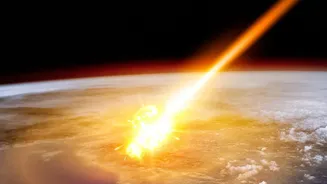
Scientists are developing planetary defense strategies for a reason. While no known asteroid currently poses a threat, thousands of large near-Earth objects are still untracked. One potential last-resort option is a nuclear device detonated near an asteroid.
The idea isn't to shatter it, but to use the intense burst of X-rays to vaporize part of its surface. This vaporized material acts like a rocket exhaust, pushing the asteroid onto a new, safer trajectory. However, new computer simulations led by Sandia physicist Nathan Moore show that the effectiveness of this push is not straightforward. The study, published in the journal Icarus, found that the direction of the blast can change the resulting deflection speed by nearly five times. 'We expected aim to matter,' Moore stated, 'What surprised us was how much.'
Why Lumpy Shapes Complicate Everything
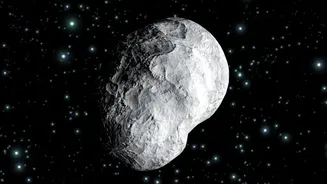
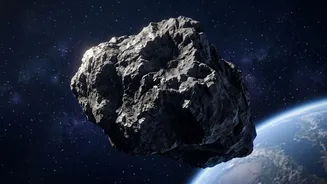
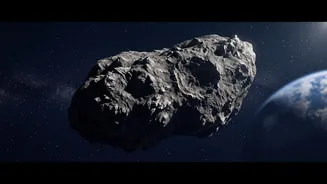
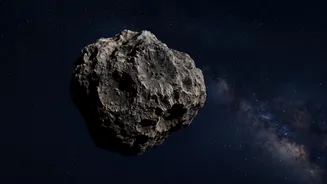
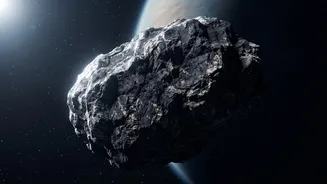
Early simulations often treated asteroids as simple spheres to make the complex calculations manageable. The problem, as Moore notes, is that 'spherical asteroids don't exist.' Real asteroids are lumpy, irregular bodies with ridges, craters, and uneven surfaces. According to the new research, these topographical features are critical. When an X-ray burst hits a flat surface, the push is relatively predictable. But when it hits a sloped or cratered area, the escaping vapor can be directed inefficiently, providing far less of a nudge. For one simulated asteroid, a blast from one direction resulted in a change of speed of 3.9 millimeters per second, while a blast from another angle only yielded 0.8 millimeters per second. The study also found that the blast's direction could alter the asteroid's spin by a factor of 17, another crucial variable in a deflection attempt.
Building a Better Asteroid Model
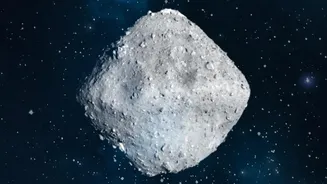
The breakthrough came from a new computer model that is over 1,600 times faster than previous methods. The team combined two existing Sandia simulation programs: one that excels at modeling high-energy events and dense materials, and another designed for weak, slow-moving forces like solar wind. This hybrid approach allowed them to create high-fidelity models of real, irregular asteroids—such as Bennu and Itokawa—without sacrificing the detailed physics of the explosion. The new tool lets researchers upload a 3D model of an asteroid and run multiple scenarios, changing the blast's size, distance, and direction to see how the object would react. This provides a much more realistic planning tool for a potential mission.
From Kinetic Impactors to Nuclear Pulses
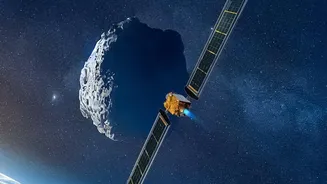
This research adds a new layer to our understanding of planetary defense, which was significantly advanced by NASA's DART (Double Asteroid Redirection Test) mission in 2022. DART successfully used a 'kinetic impactor'—slamming a spacecraft into the asteroid Dimorphos—to change its orbit. That mission proved that physically hitting an asteroid works. However, a kinetic impactor is best suited for smaller asteroids with long warning times. A nuclear option, with its vastly greater energy release, is considered a potential solution for larger asteroids or those discovered with little time to spare. The Sandia study focuses on making this powerful option more precise and controllable, ensuring the goal of a gentle nudge is achieved without accidentally breaking the asteroid into multiple hazardous fragments.
The Next Frontier in Planetary Defense
While the simulation is a powerful new tool, it has its limits. Currently, the model focuses on how the surface of the asteroid vaporizes and breaks up; it cannot yet predict if the entire body would fracture from the shock. Furthermore, any realworld mission would face immense challenges, including accurately mapping an asteroids shape and then positioning a device at the perfect spot in the vastness of space. Despite these hurdles, the research represents a major step forward. It transforms the abstract concept of asteroid deflection into a more concrete set of engineering and physics problems to be solved. As Nathan Moore put it, 'Pick the right side and you win. Guess wrong and it could be a bad day.' This study gives us a much better idea of how to pick the right side.