






Reading the Fossil Record
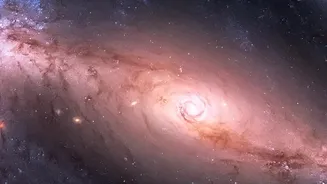
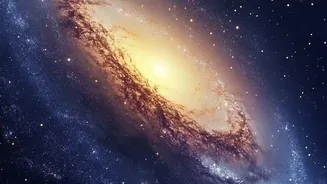
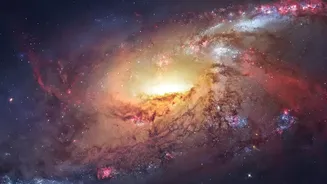
At 2.5 million light-years away, the Andromeda galaxy is so close, cosmically speaking, that it can be seen with the naked eye from a dark location. This proximity gives astronomers a unique front-row seat to study another large spiral galaxy in exquisite
detail. A monumental project called the Panchromatic Hubble Andromeda Treasury, or PHAT, has done just that. By combining multiple surveys, astronomers used the Hubble Space Telescope to meticulously map about two-thirds of Andromeda's sprawling disc, measuring the properties of around 200 million individual stars. According to the researchers, these stars act as a fossil record, preserving the history of the galaxy’s formation and evolution, with different coloured stars telling tales of different eras.
A Surprising Slowdown
The long-held, simplified model of galaxy evolution suggested that star formation happens steadily and then gradually winds down as a galaxy ages. But Andromeda's story is far more complex. The Hubble data revealed that our neighbour has been on a downward trend for about 500 million years. Five hundred million years ago, it was churning out stars at a rate of about one solar mass per year. By 40 million years ago, that rate had halved. Today, it has plummeted to just one-fifth of a solar mass annually. This isn't because the galaxy has run out of the gas and dust needed to forge new stars, but seems to be a more natural period of rest after a more energetic past.
Rings of Fading Fire
When astronomers looked closer at where this slowdown was happening, they found it wasn't uniform across the galaxy. Much of the recent star-making activity has been concentrated in a distinct ring, located about 32,000 light-years from the galactic centre. It's the fading activity within this specific ring that is driving most of the galaxy's overall decline in productivity. This pattern of rings was unexpected and pointed to a history that wasn’t a gentle, continuous process, but rather one shaped by distinct, powerful events. The question became: what could cause such a structure?
A Tale of Galactic Collision
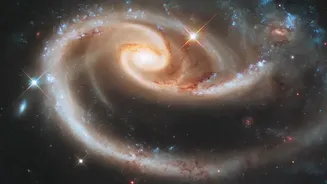
The leading theory for this ringed structure and the intense bursts of star formation that created it is a cosmic hit-and-run. Evidence suggests that around 2 billion years ago, Andromeda experienced a major burst of star formation, likely triggered by a collision and merger with another, smaller galaxy. Such a collision would have sent massive ripple effects, like shockwaves in a pond, through Andromeda's vast disk of gas. These ripples, or density waves, would have compressed the gas and dust, igniting a furious wave of star birth in their wake, creating the ring-like structures we see today.
The Likely Suspect
Scientists even have a prime suspect for this ancient disruption: M32, one of Andromeda's many small satellite galaxies. While its exact 3D location and past trajectory are still uncertain, the timing of the slowdown in star creation seems to align with a possible encounter with M32. One study noted that the part of Andromeda closest to M32 showed a drop in star formation starting around 60 million years ago. While researchers can't say for sure that M32 is the culprit, one astronomer on the project noted it is “definitely the most likely suspect.”