



The Universe’s Grandest Explosions
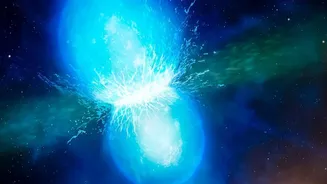
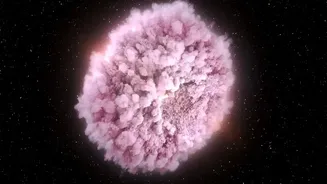
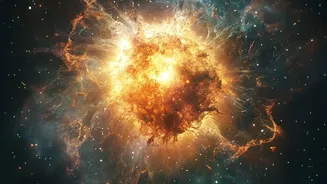
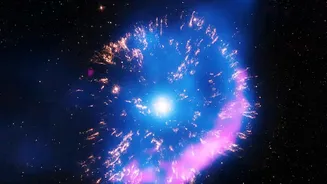
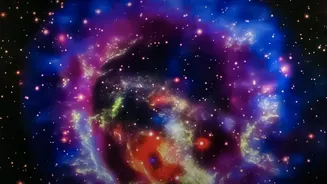
When a star much more massive than our Sun runs out of fuel, it can no longer support its own immense weight. The core collapses catastrophically in on itself, triggering a rebound shockwave that blasts the star's outer layers into space in a brilliant
explosion known as a core-collapse supernova. For a few weeks, a single supernova can outshine its entire host galaxy. These events are not just spectacular light shows; they are cosmic forges, creating and scattering heavy elements like gold and platinum across the universe. The engine driving this incredible process has long been thought to rely on a flood of incredibly small, nearly massless particles called neutrinos, which are unleashed from the collapsing core. They carry away about 99% of the energy from the collapse, and a fraction of that energy is what powers the explosion.
The Ghost Particle’s Critical Role
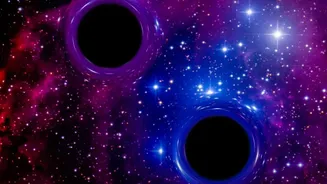
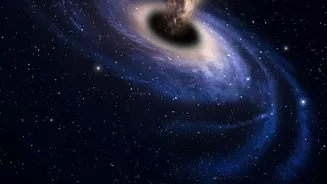
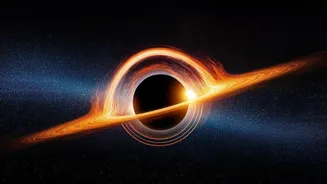
Neutrinos are often called 'ghost particles' because they barely interact with other matter. Trillions pass through your body every second without leaving a trace. However, in the incredibly dense environment of a dying star's core, so many neutrinos are produced that they create immense pressure. The conventional model of a supernova relies on these neutrinos slamming into the material just outside the core, heating it up and giving the stalled shockwave the push it needs to blow the star apart. If this neutrino heating is successful, the star explodes and leaves behind a super-dense remnant called a neutron star. If it fails, the star collapses completely into a black hole. For years, astrophysicists have used this framework, but a nagging mystery remained: they observed fewer supernovas in the sky than their models predicted.
A Cosmic Identity Crisis
The plot twist lies in a bizarre quantum feature of neutrinos: they come in three different types, or 'flavours'—electron, muon, and tau. Furthermore, as they travel, they can spontaneously change from one flavour to another in a process called 'neutrino oscillation'. This discovery, which won the 2015 Nobel Prize in Physics, was long considered a fascinating but minor detail in the context of supernovas. The different flavours interact with normal matter differently. Electron neutrinos are much more likely to interact with the star's material than muon or tau neutrinos. Therefore, the flavour of a neutrino determines how effectively it can contribute to the heating process that drives the explosion. Until recently, it was assumed that these flavour changes wouldn't significantly impact the final outcome.
When the Engine Sputters
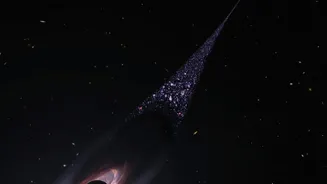
A new study from researchers at the University of Copenhagen changes that assumption entirely. By running 195 simulations of collapsing stars with masses ranging from 9 to 120 times that of our sun, they found that neutrino flavour changes can be a deciding factor in a star’s fate. The research revealed that as electron neutrinos stream out of the core and change into other, less interactive flavours, they lose their ability to push on the surrounding gas. This effectively saps the energy from the explosion's engine. The effect was particularly strong for stars between 16 and 30 times the mass of the Sun. In many simulations, stars that were expected to explode as supernovas instead failed and collapsed directly into black holes once neutrino flavour conversion was included in the model. This could help explain the 'supernova rate problem'—the missing explosions that astronomers have been searching for.
Rethinking the Cosmos
This finding isn't just about whether a star goes 'bang' or silently disappears. The distinction between a supernova and a black hole has profound consequences for the universe. Supernovas are a primary source of the heavy elements that make up planets and even life itself. If more stars are collapsing into black holes than previously thought, it could change our understanding of where these elements come from. The study also helps explain other astronomical puzzles, such as why astronomers have detected neutron stars with lower masses than theories predicted. According to Mariam Gogilashvili, the study's lead author, these findings show that neutrino flavour conversion is something that can no longer be ignored in models of how massive stars end their lives. It reveals that the fate of the largest objects in the universe might be dictated by the strange quantum behaviour of its smallest, most ghostly particles.