




Our Galaxy's Hidden Giant
For most of human history, the center of our own galaxy was a mystery, shrouded by thick clouds of gas and dust. But over decades of observation, astronomers confirmed the presence of an invisible, incredibly massive object, whose gravitational pull orchestrates
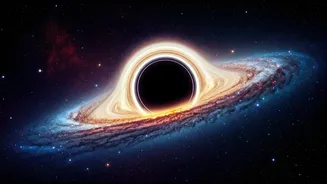
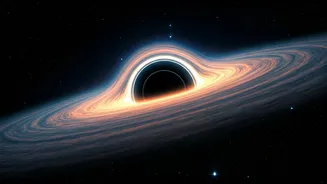
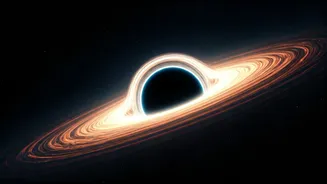
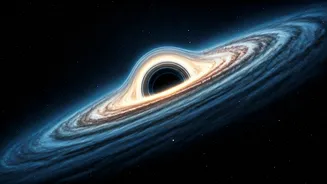
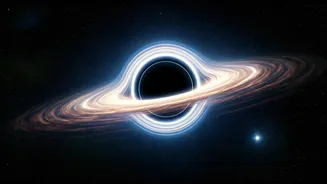
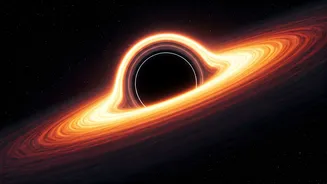
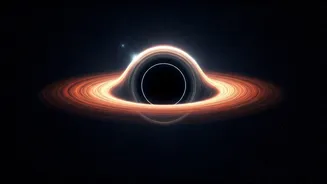
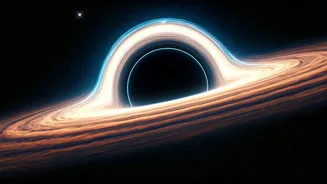
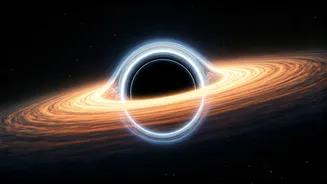
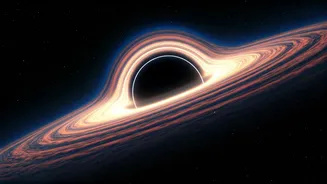
the dance of nearby stars. This is Sagittarius A, or Sgr A for short, a supermassive black hole containing the mass of four million suns. In 2022, science took a monumental leap forward when the Event Horizon Telescope collaboration unveiled the first-ever direct image of Sgr A. Located 27,000 light-years away, it appeared as a glowing, donut-like ring of super-heated gas encircling a dark shadow. This image confirmed its existence beyond a doubt but portrayed it as a relatively placid giant, especially when compared to the violent black holes seen in other galaxies.
The 50-Year Search for a Cosmic Wind
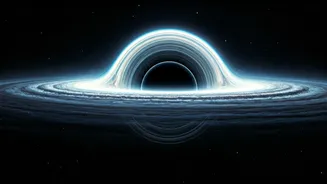
While black holes are famous for pulling things in, physicists have long predicted they should also push material out. As gas and dust spiral into a black hole’s accretion disk, the intense friction and pressure should generate enough energy to launch powerful outflows, often called “black hole winds.” This phenomenon has been readily observed in active galactic nuclei, the bright, turbulent centers of distant galaxies where black holes gorge on massive amounts of matter. However, our own Sgr A is famously a picky eater, consuming the equivalent of a single grain of rice every million years. Because of its quiet nature and the difficulty of observing the galactic center, evidence for such a wind from Sgr A remained elusive. For half a century, astronomers searched for this cosmic breeze, a key piece of the puzzle in understanding how even quiet black holes interact with their surroundings.
A Breakthrough Discovery
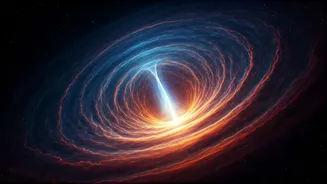
In a landmark announcement in mid-2026, a team of researchers finally found what they were looking for. Using combined data from the Atacama Large Millimeter/submillimeter Array (ALMA) in Chile and NASA’s Chandra X-ray Observatory, they detected the first clear evidence of a powerful wind blowing from Sagittarius A. The telltale sign was a massive, cone-shaped cavity in the space surrounding the black hole. This enormous void, stretching across light-years, appears to have been carved out by the persistent outflow from Sgr A. The astronomers estimate that this wind has been raging for at least 20,000 years, pushing and heating the interstellar gas in its path. After a decades-long search, the ghost had finally been found.
The Evidence in the Void
Detecting this wind was a feat of cosmic detective work. The team of scientists didn't see the wind itself, but rather the effect it had on its environment. Using ALMA, they mapped the distribution of cold molecular gas near the galactic center. They discovered a huge, cone-shaped region that was mysteriously empty of this cold gas. When they cross-referenced this with data from the Chandra X-ray telescope, they found that this exact same cavity was filled with very hot, ionized gas. The conclusion was inescapable: a hot, powerful wind flowing from the black hole had either blown all the cold gas out of the way or heated it to such a degree that it began to glow in X-rays. This provided the long-sought proof that even our relatively dormant black hole is actively shaping its galactic neighborhood.
Why It Changes Our Understanding
This discovery does more than just solve an old mystery; it provides a crucial new window into the lives of most black holes in the universe. While the 'fireworks' of highly active black holes are easier to spot, the majority of galaxies, like our own, are in a much quieter state. Sgr A* now serves as a perfect laboratory for studying this dominant, calmer phase. By confirming that even quiet black holes produce winds, scientists can better understand their subtle but profound influence on their host galaxies. These outflows can regulate the supply of gas in the galactic center, potentially suppressing the birth of new stars by blowing away the raw material needed to form them. The finding confirms that no black hole is truly isolated—they are all active engines constantly interacting with and shaping the galaxies they inhabit.