


A Celestial River Named in India
In a significant moment for Indian astronomy, researchers Rashi Jain and Yogesh Wadadekar from the National Centre for Radio Astrophysics discovered a galaxy that looks remarkably like a young Milky Way. They named it Alaknanda, after the Himalayan river
that is one of the two headstreams of the Ganga. The name is fitting, as 'Mandakini' is a traditional name for the Milky Way, making Alaknanda its celestial sister river. This discovery, made using data from the James Webb Space Telescope (JWST), connects a groundbreaking astronomical finding with a profound cultural touchstone for India.
Putting 10 Kiloparsecs in Perspective
The Alaknanda galaxy is described as being about 10 kiloparsecs (kpc) across. For those of us who don't measure our daily commute in parsecs, that number requires some translation. A single parsec is equal to about 3.26 light-years, so a kiloparsec is 3,260 light-years. This means the Alaknanda galaxy spans roughly 32,600 light-years in diameter. To put that into context, our own Milky Way galaxy is estimated to be about 30 to 34 kpc (around 100,000 light-years) across. So, while it's a massive structure, Alaknanda is about one-third the size of our home galaxy. Its central bulge alone, however, spans the full 10 kpc, making it a substantial and well-defined structure.
A Galaxy That Shouldn't Exist
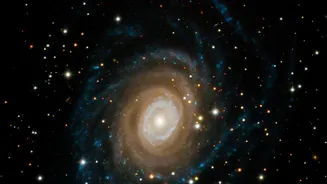
The most mind-bending aspect of Alaknanda is not just its size, but its age and structure. Its light has travelled for about 12 billion years to reach us, meaning we are seeing it as it was when the universe was only 1.5 billion years old. At this early stage of the cosmos, galaxies were expected to be chaotic, clumpy, and irregular. Yet, Alaknanda is a 'grand-design' spiral galaxy, with two perfectly formed, symmetric spiral arms. It displays a level of order and maturity that astronomers thought took many more billions of years to develop. This discovery challenges our fundamental models of how quickly galaxies could form and organize themselves after the Big Bang.
The Power of a Cosmic Magnifying Glass
Observing such a distant and detailed object was made possible by a natural phenomenon known as gravitational lensing. The Alaknanda galaxy is located behind a massive galaxy cluster called Abell 2744. The immense gravity of this cluster acts like a cosmic magnifying glass, bending and amplifying the light from Alaknanda, making it appear twice as bright to the JWST. This lucky alignment allowed Jain and Wadadekar to study its structure in incredible detail across 21 different light filters, confirming its spiral arms and powerful rate of star formation, which is about 20 times faster than in the Milky Way today.