


The Sun's Missing Element
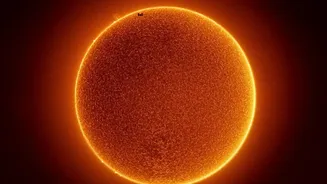
For decades, astronomers have been puzzled by the 'solar lithium problem'. Based on observations of similar stars and the composition of ancient meteorites, our Sun should have significantly more lithium than it does. Lithium is a fragile element, easily
destroyed by the high temperatures found deep inside a star. The Sun's surface is relatively cool, so the lithium there should have been preserved. Its strange absence implies that something unusual happened in our star's history, causing its outer layers to mix more than expected and drag the lithium down to its fiery doom.
Enter the Planet-Eating Sun
A new hypothesis, put forward by researchers using sophisticated computer models, offers a compelling culprit: a lost planet. The theory suggests that early in its life, our Sun consumed a 'Super-Earth'—a type of rocky planet several times more massive than our own. Published in the Monthly Notices of the Royal Astronomical Society, the study argues this cataclysmic event could neatly explain the Sun's chemical quirks. This isn't just a wild guess; the researchers ran detailed simulations to see how such an event would alter a star's evolution.
A Common Planet We Don't Have
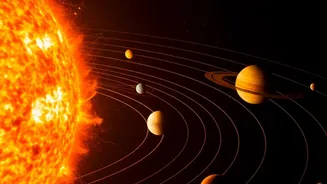
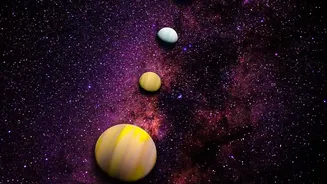
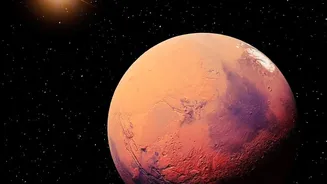
So, what is a Super-Earth? These are planets with a mass between that of Earth and Neptune. They are surprisingly common across the galaxy, found orbiting many other stars, which makes their complete absence in our own solar system something of a puzzle. According to computer simulations of planetary formation, the early solar system likely had enough raw material to form at least one. The new theory suggests a Super-Earth did form, but its orbit decayed, causing it to spiral inward until it was devoured by the young Sun.
The Cosmic Crime Scene
According to the model, as the massive planet plunged into the Sun, it wouldn't have just vanished. Instead, its immense mass would have stirred the Sun's plasma, much like dropping a large rock into a calm pond. This violent mixing would have pushed the Sun's surface material, including its lithium, deeper into the star's scorching interior where it could be destroyed. The models show that a planet between five and ten times the mass of Earth would create just the right amount of disturbance to account for the lithium levels we see today.
What the Evidence Shows
The evidence for this hypothesis comes from computer modelling and a technique called helioseismology, which studies the vibrations (or sound waves) moving through the Sun to understand its interior. The team of scientists, led by Professor Mutlu Yildiz of Ege University in Turkey, found that their model of a Sun that swallowed a planet matched current observations better than standard models. It not only explains the low lithium but also other subtle mismatches between what standard solar models predict and the Sun's observed internal structure.
A Compelling Idea, Not a Closed Case
While the planetary engulfment theory is powerful, scientists are careful to note that it remains a hypothesis. The research is based on models, not direct observation of the event, which would have happened billions of years ago. Other explanations for the solar anomalies are still possible. However, the theory elegantly solves two problems at once: why the Sun is missing lithium and why our solar system is missing a Super-Earth. The next step, researchers say, is to look for further chemical fingerprints within the Sun that could either strengthen or challenge the case for this lost world.