






A Postcard from the Edge
Ever since NASA’s New Horizons spacecraft flew past Pluto in 2015, it has been rewriting the book on this distant dwarf planet. The mission transformed our view of Pluto from a fuzzy point of light into a complex world of towering water-ice mountains
and vast, flowing glaciers. The star of the show has always been Tombaugh Regio, the stunning heart-shaped feature on its surface. The western lobe of this heart, a massive basin called Sputnik Planitia, is filled with frozen nitrogen ice and is larger than Texas and Oklahoma combined. Scientists noted that its surface is remarkably free of craters, a sign that it is geologically young and constantly being renewed. But new analysis of those decade-old images reveals a secret that may have been hiding in plain sight.
The Curious Case of the Dark Streaks
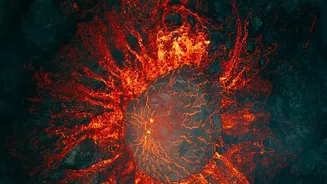
Along the northern edges of the Sputnik Planitia glacier, scientists have identified a network of dark lines and softer, diffuse patches. These features trace the boundaries of huge, city-sized polygonal cells of nitrogen ice that are slowly churning in a process called convection. For years, the origin of these streaks was a mystery. Now, a new study published in the Planetary Science Journal suggests a startling explanation. After comparing the patterns to satellite images of glaciers on Earth, researchers noted a striking resemblance to areas that have been wetted by meltwater. This raised an obvious question: if the patterns on Pluto look like they were caused by a liquid, what could possibly be 'wetting' the ice at a mind-numbing -230°C?
A World That Breathes (Nitrogen)
The leading hypothesis is that liquid nitrogen is seeping up from below the surface. While Pluto’s thin atmosphere and extreme cold make liquid nitrogen rain physically impossible, conditions might be right for it to exist underground. Scientists propose that heat from Pluto’s rocky core could be just enough to melt the nitrogen ice at the very bottom of the massive Sputnik Planitia glacier. This liquid nitrogen, which is less dense than the solid ice around it, would then be squeezed upwards through cracks and fractures. Once it reaches the surface, it would briefly flow, wetting the surrounding glacier and enlarging the ice grains before refreezing. This process would darken the ice, creating the streaks seen by New Horizons. It’s a form of cryovolcanism, or ice-based volcanism, a process that shows Pluto has a kind of active geological plumbing.
What 'Recent' Means on Pluto
The term 'recent' in geology operates on a different timescale than our own. In this context, it doesn't mean last week. Based on models of how quickly the surface of Sputnik Planitia is churning and renewing itself, scientists estimate its age to be less than one million years old. This means the dark lines must have formed sometime within that period, which is a blink of an eye in the 4.5-billion-year history of the solar system. As Alan Stern, the principal investigator for the New Horizons mission, put it, "Pluto never stops surprising us." The finding suggests that not only have liquids flowed on Pluto in its geologically recent past, but the process could even be ongoing today.
More Than Just a Frozen Heart
This discovery fundamentally changes our understanding of Pluto. It adds to a growing body of evidence that the dwarf planet is not a cold, dead world but a dynamic one that has retained enough internal heat to power geological activity. This seepage is different from the massive cryovolcanoes like Wright Mons found elsewhere on Pluto, which are thought to erupt a slushy mix of water and ammonia. The nitrogen flows on Sputnik Planitia suggest a more subtle, ongoing process. The fact that a small world so far from the Sun can support liquid flow — even of nitrogen — forces scientists to rethink the conditions required for active geology. The data from a flyby that happened over a decade ago continues to yield groundbreaking insights, proving that Pluto is one of the most fascinating and complex bodies in our solar system.