





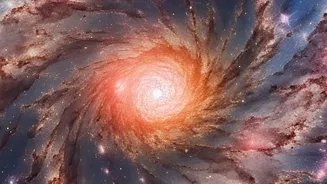
Our Majestic Galactic Neighbor
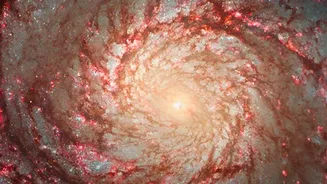
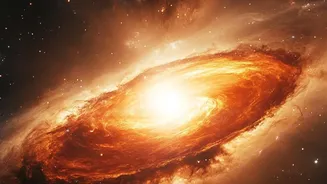
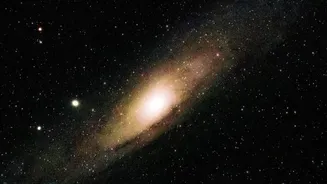
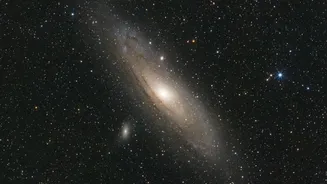
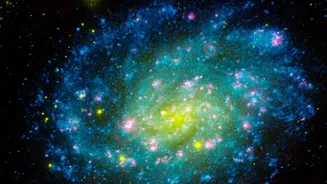
The Andromeda galaxy, also known as M31, is the closest major galaxy to our own Milky Way. On a clear, dark night, it's visible to the naked eye as a faint, fuzzy patch of light. What you're seeing is a sprawling city of stars, even larger than our own,
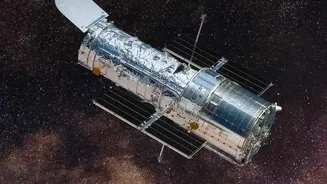
containing an estimated one trillion suns. For astronomers, Andromeda is the perfect laboratory. It's close enough for the powerful Hubble Space Telescope to resolve individual stars, yet far enough away to view its grand spiral structure in its entirety—a perspective we can never get from within the Milky Way. This unique vantage point allows scientists to create a detailed 'fossil record' of the galaxy, tracing its history by studying its diverse stellar populations.
Hubble's Unprecedented Star Census
The recent insights into Andromeda's life come from one of the most ambitious galactic surveys ever undertaken: the Panchromatic Hubble Andromeda Treasury (PHAT). Over several years, Hubble meticulously mapped about two-thirds of Andromeda’s star-forming disk, cataloging the properties of over 200 million individual stars. By analysing the colours and brightness of these stars—from hot, blue, short-lived youngsters to cooler, red, long-lived elders—astronomers were able to rewind the clock and reconstruct the galaxy's star-formation history with incredible precision. The findings, published in The Astrophysical Journal, paint a clear picture of a galaxy that is slowing down.
A Galaxy Taking a Breather
The study revealed that Andromeda’s star production has been in a steady decline for the last 500 million years. More dramatically, this slowdown has accelerated sharply within the last 40 million years. To put it in numbers, 500 million years ago, Andromeda was creating stars at a rate of about one solar mass per year. Today, that rate has plummeted to just one-fifth of a solar mass annually. Interestingly, this isn't because the galaxy is running out of the necessary gas and dust. Instead, it seems to be a natural winding-down period. Scientists believe this is the aftermath of a massive burst of star formation that occurred about 2 billion years ago, likely triggered by a merger with another galaxy. As one researcher described it, after running a cosmic marathon, Andromeda is simply taking a well-earned breather.
The Fading Ring and a Likely Suspect
The slowdown isn't uniform across the entire galaxy. Much of the decline is driven by a massive ring of gas and dust located about 32,000 light-years from the galactic center. This ring was once a hyperactive stellar nursery, responsible for a huge portion of Andromeda’s new stars. As its activity naturally fades, it drags down the entire galaxy's average. While the overall trend is one of natural decline, astronomers have also pinpointed a localized region of reduced star birth. The prime suspect is M32, a small, compact satellite galaxy orbiting Andromeda. The area of Andromeda's disk closest to M32 began to slow its star formation about 60 million years ago, suggesting an interaction between the two may have disrupted the star-making process. While researchers can't be certain, they call M32 the 'most likely suspect' in this particular cosmic mystery.