







The Planet's Fiery Heart
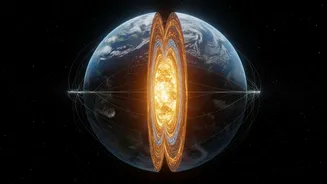
To understand this story, we have to travel thousands of kilometres straight down. The Earth has a solid metal inner core, but surrounding it is a vast ocean of liquid metal called the outer core. This layer, mostly molten iron and nickel, is about 2,200
kilometres thick and perpetually in motion, swirling and churning due to the planet's rotation and intense heat. This constant motion of electrically conductive iron is what generates Earth’s magnetic field—the vital, invisible shield that protects us from harmful solar radiation. Without it, our atmosphere could be stripped away, and life as we know it would be impossible.
A River Reverses Course
For many years, scientists believed the flow in the outer core was a relatively stable, large-scale system that predominantly moved westward. But recent findings have turned that idea on its head. In 2010, a massive section of this molten river, located deep beneath the Pacific Ocean, did something completely unexpected: it reversed direction. What was once a weak westward drift slammed on the brakes and began flowing strongly eastward. Scientists are still trying to understand the exact reasons for this dramatic and rapid change, which challenges long-held assumptions about the planet's deep interior.
How Satellites See the Core
It seems impossible to know what’s happening 2,900 kilometres underground, but this is where space technology comes in. The European Space Agency's (ESA) Swarm satellite constellation, a trio of identical spacecraft launched in 2013, is designed to measure Earth's magnetic field with incredible precision. As the satellites orbit the planet, their highly sensitive magnetometers detect tiny fluctuations in the magnetic field. By carefully analysing these signals and filtering out magnetic noise from the crust, oceans, and atmosphere, scientists can infer the movement of the molten iron that generates the field in the first place. Data from Swarm, combined with earlier missions like CHAMP and Ørsted, allowed researchers to piece together a timeline of the core’s activity and pinpoint the startling reversal.
Why This Discovery Matters
While these deep-Earth processes pose no direct danger to us on the surface, they are fundamentally important to understanding how our planet works. The magnetic field isn't static; it shifts and evolves based on the core's flow. These changes can affect everything from navigation systems to the operation of spacecraft. This reversal shows that the core can change much more rapidly than previously thought, with regional shifts occurring in just a decade. Some scientists hypothesise that this event may be linked to other observed phenomena, like changes in the inner core's rotation and abrupt shifts in the magnetic field known as 'geomagnetic jerks'.
An Unfolding Mystery
The mystery of the Pacific core-flow reversal is far from solved. Scientists are now trying to determine if this was a brief, one-off event, part of a longer, oscillating cycle, or the beginning of a new, stable pattern of flow. More recent satellite data suggests the strong eastward flow has already started to weaken since its peak, pointing towards the possibility that this was a temporary surge. Continued monitoring by the Swarm mission and others will be crucial to see how the flow evolves in the coming years. Each new piece of data helps us better understand the powerful and turbulent engine at the centre of our world.