




An Unpredictable Medley of Vehicles
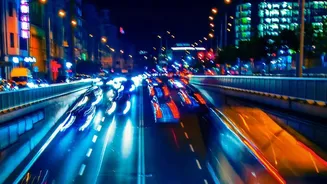
In the orderly world of computer vision, a road is filled with cars, trucks, and maybe a bus, all moving in predictable ways. Gurugram, however, operates on a different logic. Here, a self-driving car’s sensors must simultaneously identify and predict the movements
of not just cars, but also auto-rickshaws weaving through gaps, motorcycles carrying entire families, overloaded trucks, cyclists, and even the occasional bullock cart or stray animal. This heterogeneous mix, where a dozen different vehicle types with vastly different speeds and capabilities share the same space, creates a level of visual chaos that AI systems trained in more uniform environments struggle to process. A recent viral video of a Tesla’s display frantically trying to track a swarm of vehicles in Gurugram perfectly illustrates this challenge.
Where Rules Are Merely Suggestions
Autonomous vehicles are built on a foundation of rules. They expect other vehicles to stay within lanes, obey traffic signals, and follow a predictable right-of-way. In Gurugram, these rules are often treated as mere suggestions. Lane discipline is frequently non-existent, with drivers flowing like water to fill any available space. Overtaking happens from the left, U-turns are made across solid dividers, and honks and hand gestures form a complex, unwritten language that an AI cannot comprehend. The scale of this problem is evident in traffic police data. In a single week in August 2026, Gurugram traffic police issued over 24,000 challans for violations including wrong-side driving, improper lane changing, and dangerous U-turns. For a computer-vision system, this behaviour isn't just an anomaly; it's the norm, making it incredibly difficult to predict what other drivers will do next.
The Human and Animal Element
A significant challenge for any autonomous system is predicting the behaviour of pedestrians. In many Western countries, people cross at designated points. On Gurugram’s roads, however, pedestrians may cross anywhere, anytime, often emerging from behind a stopped bus or navigating through fast-moving traffic. They expect drivers to see them and adjust, a social contract that AI is not equipped to understand. Added to this are stray animals—dogs, and famously, cows—that can appear suddenly or decide to rest in the middle of a busy road. This constant, unpredictable presence of people and animals forces a level of defensive driving and split-second judgment that is currently beyond the capabilities of even the most sophisticated algorithms.
A Constantly Shifting Infrastructure
Computer vision relies on clear and consistent infrastructure: well-defined lane markings, visible signage, and updated maps. Gurugram's infrastructure presents a starkly different reality. Roads are often plagued by potholes, unmarked speed breakers, and faded or missing lane markings. Frequent construction means routes can change overnight, with closures and diversions that aren't immediately reflected in digital maps. In a telling sign of the problem, the municipal corporations in Gurugram and Manesar have recently launched an AI-based audit system just to identify and map these defects, using camera-equipped vehicles to spot everything from potholes to broken sidewalks. When the physical environment itself is unreliable and in constant flux, it becomes a monumental task for an AI to navigate safely and efficiently.
The Challenge of Dust, Glare, and Rain
Beyond the traffic itself, the physical environment poses its own set of problems for the sensors that autonomous vehicles rely on. The region's climate can lead to dust and haze, which can partially obscure the lenses of cameras and LiDAR systems. At night, the glare from the high beams of oncoming traffic—a common practice on Indian roads—can blind a car's cameras. During the monsoon season, heavy rains can reduce visibility to near zero and cause waterlogging, hiding potholes and other road hazards. These environmental factors degrade the quality of the data the AI receives, making an already difficult task even more prone to error. An AI system must be robust enough to function through all these conditions, a challenge that engineers are still working to solve.