

Meet a New Cosmic Explorer
Launched in late 2025, NASA's Interstellar Mapping and Acceleration Probe, or IMAP, is a celestial cartographer with a unique mission. Positioned about 1.5 million kilometers from Earth, it has a front-row seat to study the constant stream of particles
flowing from our Sun, known as the solar wind. But its primary job is to look much farther out, to the very edge of our solar system. IMAP’s ten sophisticated instruments are designed to intercept and analyze particles that serve as messengers from this distant frontier, giving us our first comprehensive map of the boundary separating our solar neighborhood from the vast expanse of interstellar space. The mission, led by a team from Princeton University, recently made its first batch of scientific data public, inviting scientists and enthusiasts alike to explore this uncharted territory.
Our Cosmic Protective Bubble
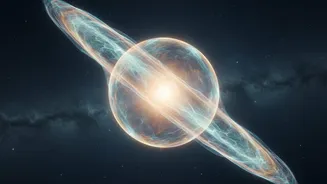
The boundary IMAP is studying is part of the heliosphere. Think of it as a giant, magnetic bubble inflated by the solar wind. This bubble surrounds our Sun and all the planets, acting as a crucial shield. As our solar system journeys through the galaxy, the heliosphere deflects the majority of high-energy galactic cosmic rays—particles from exploded stars and other extreme cosmic events that would otherwise bombard us. Without this protective shield, the level of radiation in our solar system would be much higher, potentially making it impossible for life as we know it to exist. The region where the solar wind's outward push is finally halted by the pressure of the interstellar medium is called the heliopause—this is the edge IMAP is mapping.
The First Glimpse of the Frontier
The first public data from seven of IMAP's instruments is a scientific milestone. This initial dataset offers a fresh look at the particles and magnetic fields that make up the space environment near Earth and beyond. While some instruments measure the solar wind directly, others are designed to detect something more elusive: energetic neutral atoms, or ENAs. These particles are created at the very edge of the heliosphere when the hot, charged particles of the solar wind collide with cold, neutral atoms from interstellar space. In this exchange, a solar wind particle can steal an electron, becoming electrically neutral. No longer bound by magnetic fields, it travels in a straight line, with some of these messengers making the long journey back toward IMAP.
Why This Cosmic Map Matters
Mapping the heliosphere isn't just about satisfying our curiosity. Understanding the structure and strength of this shield has profound practical implications. The galactic cosmic rays it filters out pose a significant threat to astronauts on long-duration missions, such as trips to Mars, and can damage sensitive satellite technology. By observing how the heliosphere breathes—expanding and contracting in response to the Sun's 11-year activity cycle—scientists can improve models of space weather. In fact, IMAP also provides a real-time data stream called I-ALiRT that gives forecasters advance warning of incoming solar energetic particles, which can disrupt power grids and communications on Earth. This mission provides a vital two-for-one benefit: exploring the galaxy while also protecting our interests closer to home.