
Meet the 'Ghost Particle'
Trillions of particles called neutrinos pass through your body every second, yet you’ll never feel them. They are fundamental building blocks of the universe, but they are electrically neutral and interact so weakly with other matter that they are nicknamed
'ghost particles'. They are produced in the nuclear reactions inside stars, like our sun, and in cataclysmic events like a supernova, which is the explosive death of a massive star. Because they are so elusive, they can escape the incredibly dense core of a dying star and carry away vital information about the processes happening deep inside.
A Star's Final Moments
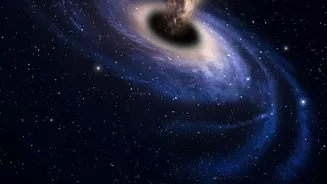
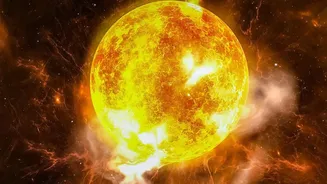
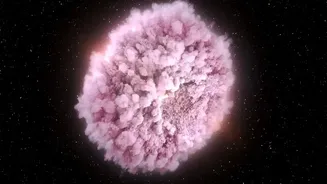
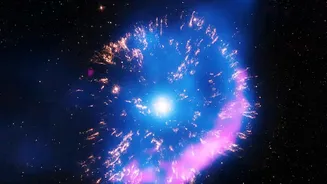
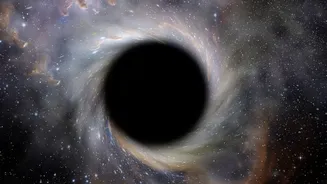
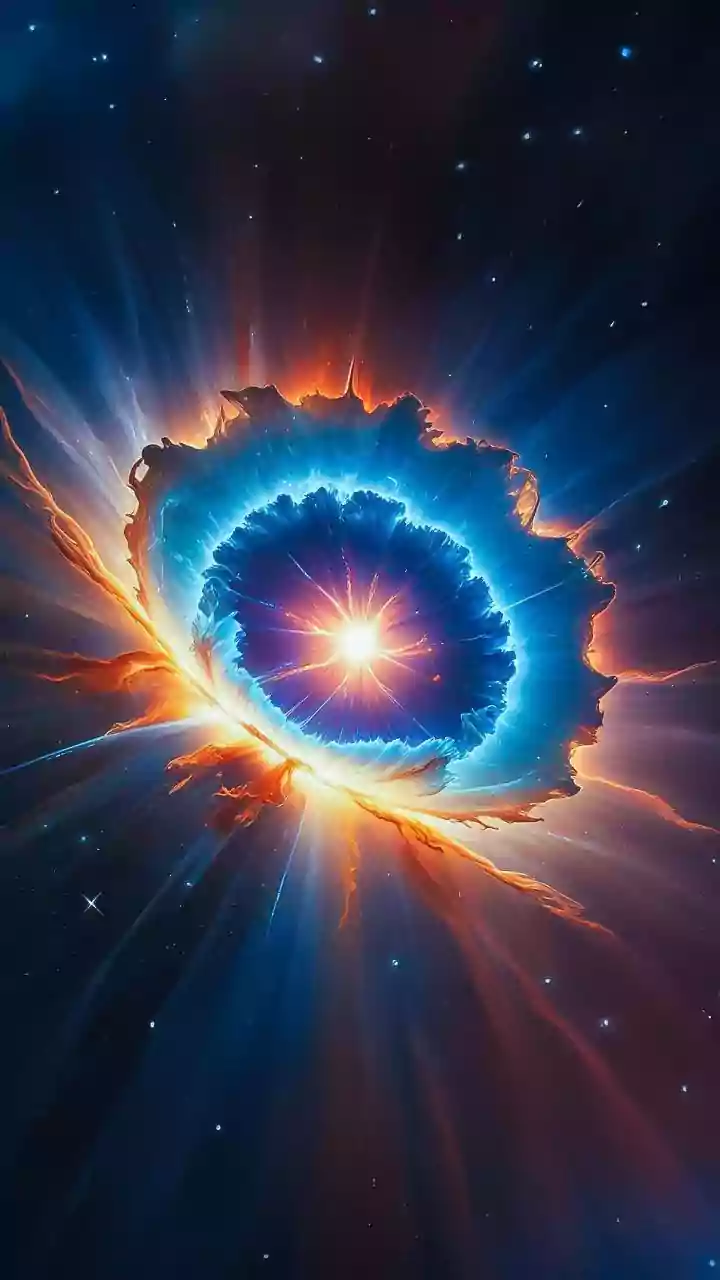
When a star many times more massive than our sun exhausts its nuclear fuel, it can no longer support its own immense weight. The core implodes catastrophically, crushing protons and electrons together to form neutrons and releasing a staggering flood of neutrinos. In fact, about 99% of the energy from a collapsing star is carried away by these ghost particles. This torrent of neutrinos is thought to be responsible for powering the subsequent outward explosion, known as a supernova, which blasts the star's outer layers into space and leaves behind a super-dense neutron star. However, sometimes this explosion fails, and the entire star collapses in on itself to form a black hole. Scientists have long puzzled over what tips the balance.
A Surprising Identity Crisis
Neutrinos come in three different types, or 'flavours': electron, muon, and tau. A Nobel Prize-winning discovery revealed that these particles can spontaneously change from one flavour to another as they travel, a process called oscillation or flavour conversion. For a long time, astrophysicists believed this flavour-changing had little effect on the outcome of a supernova. However, a new study from researchers at the University of Copenhagen suggests this assumption was wrong. They ran 195 simulations of collapsing stars, ranging from 9 to 120 times the mass of the Sun, and found that including neutrino flavour conversion dramatically changed the results.
The Deciding Factor in Star Death
The study revealed that the fate of stars, particularly those between 16 and 30 times the Sun's mass, was highly sensitive to neutrino physics. When flavour conversions were included in the models, many stars that were predicted to explode as supernovae instead failed and collapsed directly into black holes. The reason is that different flavours of neutrinos interact with matter differently. An electron neutrino is more likely to interact with the star's material than the other two flavours. By changing flavour, the neutrinos can alter how much energy they deposit into the layers surrounding the star's core, which can be the difference between a successful explosion and a failed one. This finding may help explain cosmic mysteries, like why astronomers observe fewer supernovae than our theories predict.
Cosmic Drama, Not Earthly Danger
While the idea of a star collapsing into a black hole sounds alarming, these events pose no threat to Earth. For one, the stars massive enough to undergo this process are all very far away. But more importantly, neutrinos themselves are fundamentally harmless under normal circumstances. Even the immense flood of neutrinos from a nearby supernova would pass through our planet with almost no detectable effect. The energy they deposit is minuscule compared to the heat already generated within the Earth's core. This new research is about understanding the fundamental physics of the universe and the life cycle of stars, not about predicting a new type of cosmic hazard.