






A World That Won't Sit Still
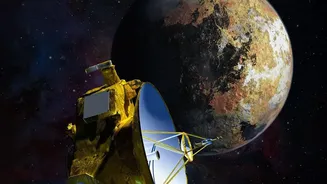
For decades, our image of Pluto was that of a distant, inactive ice ball. But when NASA's New Horizons spacecraft flew past it in 2015, it revealed a stunningly complex and active world. Recent analysis of these high-resolution images has provided the most
compelling evidence yet that Pluto's surface is changing in ways that are, in geological terms, incredibly recent. The focus of this discovery is Sputnik Planitia, the vast, heart-shaped basin of frozen nitrogen that dominates Pluto's appearance. Scientists have found features that suggest liquid nitrogen may be periodically welling up from beneath the surface, a process that re-shapes the landscape.
The Evidence in the Ice
The key evidence comes from dark streaks and patches found along the northern edge of the Sputnik Planitia glacier. These features strongly resemble patterns seen on Earth's own glaciers when they are wetted by liquid, such as from rainfall or subsurface meltwater. On Pluto, where the temperature is far too low for liquid water or nitrogen rain, the most likely explanation is liquid nitrogen flowing up from below. Computer models support this idea, showing that nitrogen ice at the base of the kilometers-deep glacier could melt under pressure, become buoyant, and rise through fissures in the ice, much like lava through volcanic tubes on Earth. This process, known as basal melting, suggests a form of active 'plumbing' beneath Pluto's icy shell.
What 'Human Timescales' Means
The headline's phrase "human timescales" can be misleading. It doesn't mean you could watch the surface change in an afternoon. Rather, it refers to geological events that have happened very recently. Scientists believe the surface of Sputnik Planitia is likely less than a million years old, a mere blink of an eye in the 4.5-billion-year history of the solar system. The features caused by the liquid nitrogen must have formed within that timeframe. This is in stark contrast to the billions of years over which most planetary surfaces evolve. The discovery suggests these liquid nitrogen flows could be occasional, temporary events, happening in intense pulses that last for hours or days before refreezing. This points to a new kind of time-variable feature on Pluto, a world once thought to be unchanging.
Rewriting the Textbooks on Icy Worlds
This finding fundamentally alters our understanding of dwarf planets. It demonstrates that even a small, distant world, far from the Sun's warmth, can harbor enough internal heat to drive geological activity. The idea that Pluto might have liquid flowing on it—even if it's liquid nitrogen and not water—was once unthinkable. It forces a rewrite of the old narrative that small, icy bodies are simply inert relics from the formation of the solar system. This activity could also help explain mysteries elsewhere, such as the strange geysers observed on Neptune's moon Triton, which may be powered by a similar mechanism. The discoveries on Pluto suggest that the outer solar system may be home to many more active and evolving worlds than we ever imagined.