





The Bedrock of Technique
Before we can add any layers of awareness, we must first understand what Tai Chi is at its core. It is an ancient Chinese martial art often described as 'meditation in motion'. But it is also a discipline built on a foundation of precise techniques. Each
posture, from 'Parting the Wild Horse's Mane' to 'White Crane Spreads Its Wings', has a purpose and a correct form. This technique governs everything: proper body alignment, the smooth transition between movements, and the principles of rooting your body to the ground while maintaining a fluid grace. Learning these forms is not merely about memorising a sequence; it is about teaching the body to move with intention, balance, and strength. Without this technical foundation, the practice loses its structure and many of its physical benefits, such as improved balance, flexibility, and coordination. This structure is the essential framework upon which everything else is built.
What is Mindful Observation?
Mindfulness, at its heart, is the simple practice of paying attention to the present moment without judgment. It’s about noticing your thoughts, feelings, and bodily sensations as they are, without getting carried away by them. Mindful observation is the active component of this, where you intentionally direct your awareness to the sensory information you are receiving. It is a way of anchoring yourself in the 'now'. In a busy life, our minds are often elsewhere—worrying about the future or replaying the past. Mindfulness brings the focus back to the present. This practice is not about emptying the mind, which can feel like an impossible task, but rather giving it something concrete and present to focus on.
A Synergy on the Shore
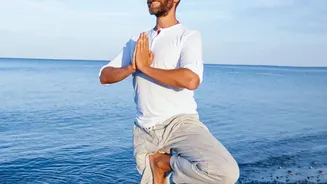
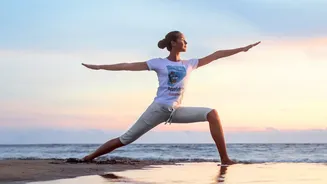
A beach is perhaps the perfect laboratory for combining Tai Chi technique with mindful observation. The environment offers a rich tapestry of sensory experiences that can be used as focal points. Instead of being distractions, these elements become tools for deeper immersion. The rhythmic sound of the waves can become a natural guide for your breathing, helping you synchronise breath with movement and enhance relaxation. The feeling of the soft, uneven sand under your feet forces you to be more aware of your weight distribution and balance, improving proprioception—your body's sense of its position in space. You can focus on the sensation of the cool sea breeze on your skin or the warmth of the sun. Practicing during sunrise or sunset adds a visual element that promotes peace and concentration. This sensory engagement keeps your mind from wandering and grounds you completely in the physical act of the practice.
How Observation Enhances Technique
This is where the two concepts truly merge. Mindful observation does not detract from technique; it deepens it. By mindfully observing the way your body shifts and adjusts on the sand, you gain a more intuitive understanding of the Tai Chi principle of 'rooting'. Noticing the flow of your breath as it aligns with the ocean's rhythm can refine the fluidity and grace of your movements. Being acutely aware of your internal state—the sensations in your muscles and joints as you move through a form—allows you to make subtle adjustments, improving alignment and preventing injury. This state of 'moving mindfulness' transforms the practice from a purely physical exercise into a holistic mind-body experience. Studies have even shown that a mindfulness-enhanced Tai Chi practice can lead to greater improvements in mental and physical well-being compared to traditional instruction alone.
A Complement, Not a Shortcut
It is crucial, however, to remember the hierarchy here. Mindful observation is a powerful complement, but it is not a substitute for learning and respecting the discipline's technical aspects. One cannot simply go to the beach and wave their arms in a 'mindful' way and call it Tai Chi. The full benefits—physical, mental, and energetic—come from the integration of both elements. The form provides the 'what' and the 'how', while mindfulness provides the 'where' and the 'when'—right here, right now. The technique is the vessel; the mindful awareness is the water that fills it. Without the vessel, the water has no form. Without the water, the vessel is empty. They work in concert, creating a practice that is far more than the sum of its parts.