




A Walk Through Time
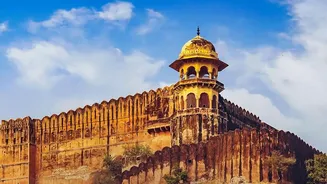
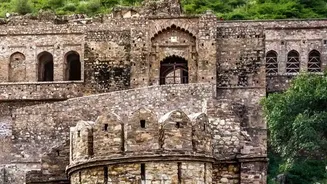
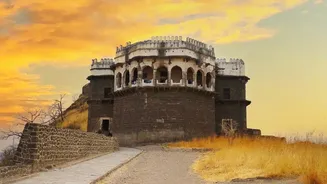
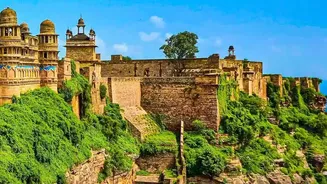
Across India, colossal forts and formidable city walls stand as silent witnesses to history. Built for defense, these ramparts were designed to intimidate invaders and protect citizens. Today, their role has transformed. They have become unique promenades,
offering travellers a chance to walk along the very edge of history. From these elevated platforms, the past and present of a city converge. Below, the chaotic symphony of modern urban life unfolds, while underfoot, each stone tells a story of kingdoms, battles, and centuries of endurance. This elevated perspective is not just about a panoramic photo; it is about understanding the very layout and soul of a city, tracing its growth from a fortified core to a sprawling metropolis.
Jodhpur: The Blue City from Above
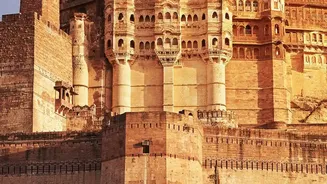
Mehrangarh Fort, perched on a 400-foot cliff, dominates the Jodhpur skyline. Its massive ramparts, with walls up to 36 metres high, offer what is arguably one of the most breathtaking views in India. From this vantage point, the famous 'Blue City' unfolds below like a vast, indigo carpet. Walking along the battlements, past cannons that still stand silent guard, you can trace the city's old boundaries and see how it has spilled into the surrounding desert. The imprints of cannonballs on the fort’s gates are a visceral reminder of its turbulent past. This perspective, praised by writers like Rudyard Kipling, is not just geographical but also temporal, connecting you directly to the era of the Rathore clan.
Jaisalmer: The Living Golden Fort
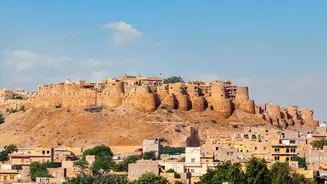
Jaisalmer Fort is unique; it is one of the few 'living forts' in the world. Nearly a quarter of the old city's population still resides within its golden sandstone walls. Walking the ramparts here offers a perspective that is less about observation and more about participation. You are not just looking down at a city; you are moving through the upper crust of a vibrant, inhabited community. The fort, also known as Sonar Quila, was built in 1156 and features three layers of fortified walls and 99 bastions. From its highest points, you can see the intricate maze of narrow lanes, intricately carved havelis, and bustling markets, all contained within the ancient structure, looking like a sandcastle rising from the Thar Desert.
Chittorgarh: A Saga in Stone
As one of the largest forts in India and a UNESCO World Heritage Site, Chittorgarh is a sprawling complex spread over a 180-metre-high hill. Its perimeter wall, running for about 13 kilometres, encloses palaces, temples, and memorials, each echoing with tales of Rajput valour and sacrifice. To walk its ramparts is to traverse a landscape of immense historical weight. The sheer scale is staggering, encompassing 65 historic structures. Unlike forts that dominate a city, Chittorgarh was the city. The view from its walls is not of a bustling metropolis at its feet, but of the vast plains of Mewar, emphasizing the isolation and self-sufficiency that defined its history. It provides a solemn, powerful perspective on the price of sovereignty.
Jaipur: The Planned Pink City's Outline
The ramparts of Jaipur, known as the Parkota, offer a different kind of insight. Encircling the old planned city founded in 1727, these six-meter-high walls defined the original grid of one of India's earliest planned urban centres. While some sections have been lost to modern development, tracing their path reveals the incredible foresight of Maharaja Sawai Jai Singh II. The walls and its seven original gates were not just for defense but also defined the city's commercial and cultural sectors. Seeing the ordered markets and chaupars (squares) from this outer boundary provides a masterclass in 18th-century urban design, a clear contrast to the organic, winding growth seen in many other ancient cities.