


A New Eye on the Cosmos
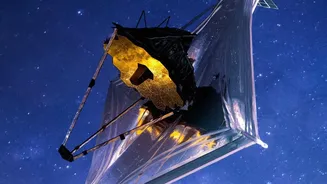
Named after Dr. Nancy Grace Roman, NASA’s first chief of astronomy and the ‘mother of the Hubble Space Telescope’, the Roman mission is set to expand on her legacy in a monumental way. Launched in August 2026, this advanced observatory is designed to tackle
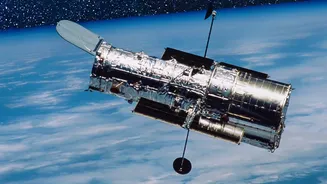
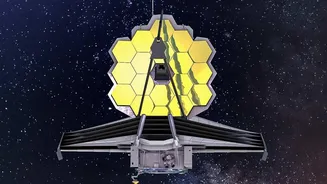
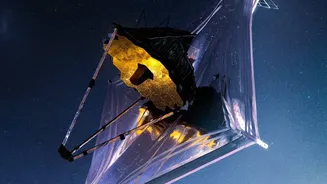
some of the biggest questions in astrophysics today. With a primary mirror the same size as Hubble's—2.4 meters (7.9 feet) in diameter—it has a familiar foundation. However, its scientific power comes from a revolutionary instrument that will allow it to see the universe with an entirely new perspective. The telescope orbits at the second Sun-Earth Lagrange point (L2), a stable location about 1 million miles from Earth, which it shares with the James Webb Space Telescope.
Seeing the Bigger Picture
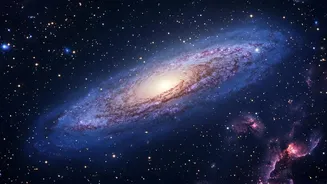
Roman's superstar feature is its Wide Field Instrument (WFI), a 300-megapixel camera that gives it a field of view at least 100 times larger than Hubble's. Think of it this way: if Hubble is a zoom lens, providing incredibly detailed but narrow views, Roman is a wide-angle lens. Where Hubble would need to take hundreds of individual photos to map a large celestial feature like the Andromeda galaxy, Roman can capture a similar area with far fewer shots, and with the same stunning resolution. This incredible efficiency means Roman can survey huge portions of the sky up to 1,000 times faster than its famous predecessor. A task that might take Hubble a century could be completed by Roman in about a month. This capability is essential for building vast cosmic maps and detecting rare, fleeting events that would otherwise be missed.
Unraveling Cosmic Mysteries
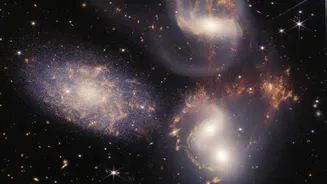
Two of the most profound puzzles in modern physics are dark energy and dark matter. Dark energy is the mysterious force believed to be causing the universe's expansion to accelerate, while dark matter is the unseen material that provides the gravitational scaffolding for galaxies. Together, they make up about 95% of the cosmos, yet we know very little about them. Roman's primary mission is to shed light on these enigmas. By surveying over a billion galaxies and observing distant supernovae, the telescope will create a 3D map of the universe, allowing scientists to trace its expansion history and see how cosmic structures have evolved over time. These large-scale surveys will help astronomers understand the influence of dark matter and test whether our fundamental model of the universe is correct.
A Galactic Census of Planets
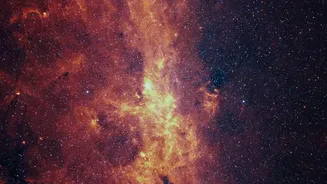
Beyond cosmology, Roman is a powerful planet-hunting machine. While missions like Kepler stared at small patches of sky, Roman will conduct a massive survey of the inner Milky Way, using a technique called gravitational microlensing. This method detects planets by observing how their gravity briefly magnifies the light of a more distant star that happens to align perfectly. Because it relies on gravity, microlensing can find planets that are much smaller or farther from their star than other methods can easily detect, including rogue planets that drift through space without a stellar host. Scientists anticipate Roman will discover thousands of new exoplanets, creating a statistical census that will help us understand how common planetary systems like our own solar system truly are. In addition, a technology demonstration called a Coronagraph will test methods for directly imaging planets by blocking their host star's light.