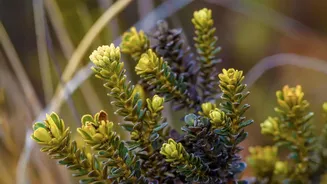








A Plant with Deep Roots in Tradition
Native to South Africa, the sour fig is a hardy, creeping plant known for its fleshy leaves and bright, daisy-like flowers. For centuries, indigenous communities, particularly the Khoisan people, have revered it for its diverse medicinal properties. Traditional
uses are extensive and well-documented. The astringent juice from its leaves was commonly used as a potent antiseptic. It was applied topically as a pulp or juice to soothe wounds, burns, eczema, and other skin infections to promote healing and prevent infection. Internally, it was taken for a host of ailments. Gargling with the leaf juice was a go-to remedy for sore throats and mouth infections, including oral thrush. It was also used to treat digestive issues like diarrhoea and dysentery, and even for conditions like tuberculosis and diabetes. This rich history of healing laid the foundation for future scientific curiosity into what makes the plant work.
What's Inside? The Promising Chemistry
The long history of sour fig's use in folk medicine has prompted scientists to look closer at its chemical makeup, and what they've found is certainly intriguing. The plant is rich in bioactive compounds that are known to have therapeutic effects. Key among these are polyphenols, flavonoids, tannins, and various acids like ferulic acid. Flavonoids and phenols are powerful antioxidants, which are molecules that help protect our cells from damage caused by unstable molecules called free radicals. Tannins are known for their astringent properties, meaning they can cause tissues to contract, which helps explain the plant's traditional use in wound healing and for treating diarrhoea. Laboratory studies, known as in-vitro and in-vivo research, have validated some of these traditional applications. Extracts from sour fig have shown significant antimicrobial activity against a range of bacteria and fungi, including E. coli and Staphylococcus aureus. Its anti-inflammatory and antioxidant properties have also been confirmed in lab settings, supporting its use for inflammatory conditions.
The Gap Between the Lab and the Clinic
This is where the second part of the headline comes into play. While the plant’s chemistry is promising and lab studies back up many traditional claims, there is a significant lack of rigorous, large-scale human clinical trials. A positive result in a petri dish or an animal study does not automatically mean a substance will be safe and effective for humans. Clinical trials are the gold standard for medical proof, and they are complex, expensive, and time-consuming. For plant-based medicines, the process is even more complicated. The chemical composition of a plant can vary widely depending on the season, soil, and location where it was grown, making it difficult to create a standardized dose for a trial. Without these large-scale human studies, it's impossible for medical bodies to approve sour fig as a treatment for any specific condition. Most of the available literature concludes by stating that while the folkloric use is supported by phytochemical and preliminary lab data, further studies are essential to validate its therapeutic use in humans.
So, What's the Verdict?
The story of the sour fig is a common one in the world of natural remedies: a long and respected history of traditional use, a plausible scientific basis for its effects, but a lack of definitive clinical proof. While its leaf juice is reportedly non-toxic in traditional applications, this doesn't mean it's without risk or a substitute for conventional medical treatment. The plant's effectiveness as an antiseptic for minor external scrapes or as a soothing gargle is one thing, but relying on it for serious conditions like diabetes or tuberculosis, as was done traditionally, is not advisable in the age of evidence-based medicine. Appreciating the sour fig means respecting its cultural heritage and its potential, while also acknowledging the limits of current scientific knowledge. It stands as a fascinating example of where traditional wisdom and modern science intersect, highlighting a plant that is certainly interesting, but not yet clinically proven.