


A Curious Discovery in Gale Crater
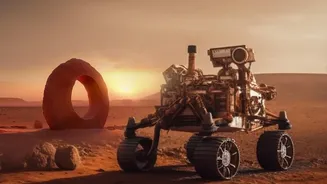
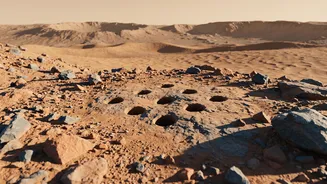
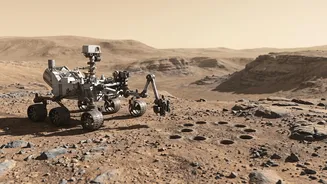
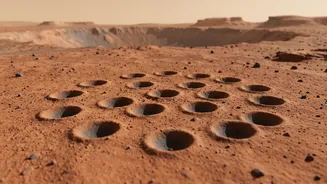
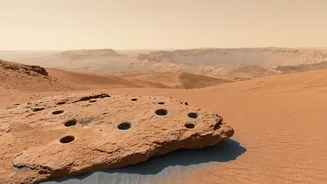
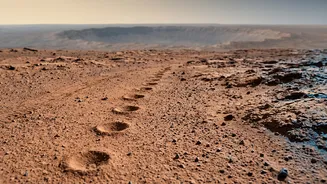
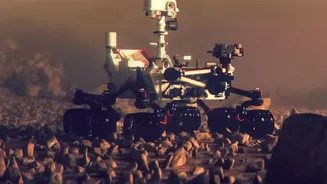
While climbing through a region known as Valle Grande on Mount Sharp, the Curiosity rover spotted something unusual dotting the rocky terrain. It wasn't the dramatic crater from a meteorite impact, which are common on Mars, but rather a collection of
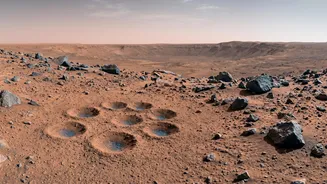
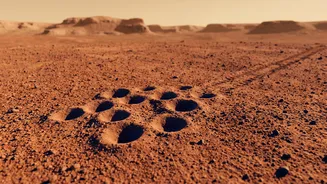
small, shallow divots in the ground. For a rover that has been exploring the 154-kilometre-wide Gale Crater for over 14 years, seeing something entirely new is a significant event. The discovery was intriguing enough for the mission's science team to pause and command the rover to take a much closer look, recognizing that these features were unlike anything documented before.
What Makes These Holes So Strange?
Holes and pits are not inherently new to Mars. Often, they are the predictable result of a process called differential erosion. This happens when hard mineral clusters, or nodules, are embedded in softer bedrock. Over eons, the softer rock erodes away, and the harder nodule eventually falls out, leaving a small cavity behind. But these newfound holes don't fit that model. According to NASA scientists, the pits are unusually broad and shallow, and crucially, there are no obvious nodules or pebbles nearby that look like they once occupied the spaces. One of the holes photographed in detail measures only about a centimetre across, highlighting the small scale of this new Martian mystery.
Unpacking the Data from Millions of Miles Away
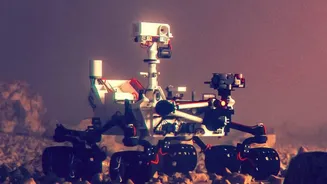
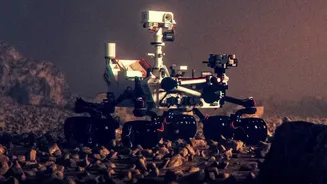
When a puzzle like this appears, NASA's teams on Earth spring into action. They have a suite of powerful instruments aboard Curiosity to play detective. To investigate the holes, the rover used its Mars Hand Lens Imager (MAHLI) to capture detailed, close-range photographs. Simultaneously, its Mastcam cameras took a series of overlapping stereo images of the surrounding area. This technique allows scientists to build three-dimensional models of the surface. By analysing these 3D reconstructions, the team can precisely measure the pits' shape, depth, and volume, which are critical clues needed to work backwards and figure out how they formed.
Geology, Gas, or Something Else?
Without a clear explanation, scientists are considering several possibilities. The holes could be the result of an unfamiliar erosion process or a unique property of this specific type of rock. This area of Mars is already of particular interest. In the same valley, Curiosity recently found a vast, surprising landscape of honeycomb-like polygonal fractures. These formations are thought to be related to drying mud or thermal cycles from Mars's distant, wetter past. The strange holes could be linked to these other unique geological features, perhaps caused by escaping gas that bubbled up through ancient sediment. For now, there is no definitive link to biological activity; the mystery is purely geological. Scientists are careful to avoid jumping to conclusions, focusing instead on what the data can prove.
Why 'Baffled' Is a Good Thing in Science
While headlines might say scientists are 'baffled', a more accurate word is 'intrigued'. In science, the unknown is not a failure but an opportunity. Finding something that doesn't fit existing models is exciting because it points to a gap in our understanding and a chance for new knowledge. Each time Curiosity uncovers a new mineral, a strange rock texture, or an unexplained feature like these holes, it provides a richer, more complex picture of Mars's history. These pits, along with other recent discoveries of diverse organic molecules, are clues that help scientists reconstruct how the Martian climate and environment changed over billions of years, from a world with lakes and streams to the cold, dry planet we see today.