








Inside the New Chennai Facilities
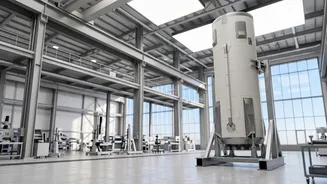
Agnikul recently inaugurated two new crucial facilities at its Chennai campus: the Stage Testing & Inspection Facility (STIF) and the Pressurant Tank Realisation, Over-wrapping and Outfitting Facility (PROOF). The inauguration was attended by notable
figures including Group Captain Shubhanshu Shukla, one of India's astronaut-designates for the Gaganyaan mission. STIF is the star of the show, designed entirely in-house to test complete, reusable rocket stages under the intense conditions they would experience during a real flight. PROOF, meanwhile, brings the production of vital high-pressure vessels in-house, giving Agnikul greater control over its supply chain and production timelines.
Why Reusability Is a Game-Changer
For decades, rockets were single-use machines. The most expensive and complex parts would burn up in the atmosphere or fall into the ocean after just one flight. Reusable rocketry, pioneered globally by companies like SpaceX, changes this equation entirely. The goal is to recover the first stage of a rocket—the largest and most powerful part—and fly it again. This drastically cuts the cost of a launch, making access to space more affordable for satellite companies, researchers, and national space programs. By mastering reusability, a company can move from being a boutique rocket builder to a high-frequency launch provider, transforming the economics of the entire industry.
Building on Historic Success
This new infrastructure is the logical next step for Agnikul following its landmark achievement on May 30, 2024. On that day, the company successfully launched its Agnibaan SOrTeD (SubOrbital Technological Demonstrator). The mission was historic for several reasons: it was the first launch from a private launchpad in India, and it featured the first successful flight of a semi-cryogenic engine developed in the country. The engine itself, the Agnilet, is the world's first fully 3D-printed, single-piece rocket engine. Having proven its core engine technology can fly, Agnikul is now building the infrastructure needed to recover, test, and reuse it.
The Challenge of 'Flight-Proven'
The key capability of the new STIF facility is not just testing, but 'requalification'. This makes Agnikul the only private company in India with the in-house infrastructure to inspect a recovered rocket stage and certify it as safe for another flight. This is the most difficult part of reusability. It involves a meticulous process of checking every component for stress, fatigue, and damage after the immense forces of launch and re-entry. Developing this repeatable cycle of building, flying, recovering, inspecting, and requalifying is the core engineering challenge that separates a one-off tech demo from a commercially viable, reusable launch system.
Powering India's Private Space Ambitions
Agnikul's progress aligns perfectly with India's national strategy. The government, through the Indian National Space Promotion and Authorisation Centre (IN-SPACe), is actively fostering a vibrant private space ecosystem. The goal is ambitious: to grow India's share of the global space economy from its current valuation of around $8.4 billion to $44 billion by 2033. Achieving this target is impossible with government resources alone; it requires massive private investment, industrial capacity, and innovation from startups like Agnikul. By developing cutting-edge technology like 3D-printed engines and reusable stages, Agnikul is positioning itself as a leader in this new, liberalised space era for India.