

A Celestial Lion Roars to Life
The new image showcases the planetary nebula, officially known as NGC 2392, in a spectacular display of cosmic artistry. What we see is not a place of creation, but rather the beautiful and complex end of a star's life. At its centre sits a very hot,
dense remnant of a star called a white dwarf. This stellar core, which looks like the button nose of a lion, is fiercely blasting radiation into clouds of gas and dust that the star shed thousands of years ago. This process carves out the nebula's distinct shape, with a glowing inner bubble forming the lion's 'face' and an outer, more delicate structure creating its magnificent 'mane'. The image, a composite from Webb’s Near-Infrared and Mid-Infrared instruments, presents the nebula in stunning pink and cyan hues.
Webb's Infrared Advantage
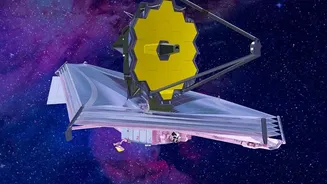
While the Hubble Space Telescope gave us a memorable view of the Lion Nebula in visible light back in 2000, the James Webb Space Telescope's power lies in its ability to see the universe in infrared light. This allows it to peer through obscuring layers of cosmic dust and gas that are opaque to other telescopes. For the Lion Nebula, this means Webb can reveal hidden details within the lion's mane that were previously invisible. These newly visible features include dense, surviving clumps of dust and hazy regions of superheated, ionized gas, providing a much clearer picture of how the dying star is sculpting its environment. Webb's vision cuts through the cosmic fog, giving scientists a front-row seat to this dramatic celestial event.
The Science Behind the Spectacle
This image is far more than just a pretty picture; it is a rich scientific dataset. The Lion Nebula is a planetary nebula, a name that is a historical misnomer as it has nothing to do with planets. It is formed when a star similar to our own Sun runs out of fuel and expels its outer layers into space. The central white dwarf is now so hot that its intense radiation is essentially 'cooking' the surrounding material from the inside out. This creates a bubble of expanding gas that crashes into the slower-moving material ejected earlier, forming the complex shells and filaments we see. Scientists are studying these intricate structures to better understand the final life stages of Sun-like stars and the processes that enrich the galaxy with heavier elements.
A Fleeting Cosmic Moment
Despite its grand appearance, the Lion Nebula is a temporary celestial object. The structures we see today have taken several thousand years to form, and they are in a constant state of change. The powerful radiation and stellar winds from the central white dwarf continue to push the gas and dust outwards. Astronomers estimate that in about 10,000 years, a relatively short time in cosmic terms, the entire nebula will have expanded and dissipated into space, leaving behind only the cooling white dwarf. Webb's image, therefore, is a remarkable snapshot of a fleeting, yet profoundly important, phase in a star's evolution, offering clues to the past and future of stars throughout our galaxy.