



A New Eye on the Cosmos
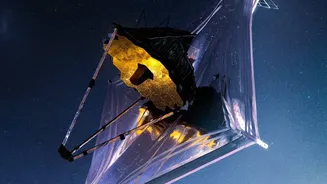
Imagine trying to take a panoramic photo of a sprawling city, but your camera can only capture a single brick at a time. That has been the challenge for astronomers trying to map the universe. Now, there's a new tool with a much wider lens. The Nancy
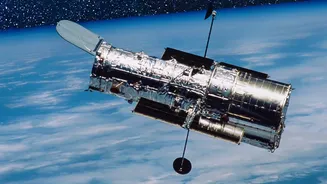
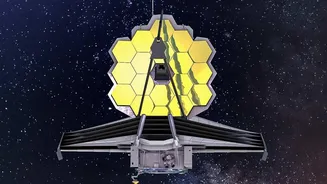
Grace Roman Space Telescope, which successfully launched on August 30, 2026, is NASA's next-generation observatory. It boasts a primary mirror the same size as the Hubble Space Telescope's but features a revolutionary Wide-Field Instrument (WFI). This instrument allows it to capture a patch of the sky at least 100 times larger than Hubble can in a single snapshot, with the same exquisite detail. This incredible efficiency means that in just one year of operation, Roman can achieve what might have taken Hubble a thousand years. Its primary mission is to settle fundamental questions about dark energy and dark matter, discover thousands of new exoplanets, and provide unprecedented views of our own galaxy and beyond.
Mapping the Cosmic Web in 3D
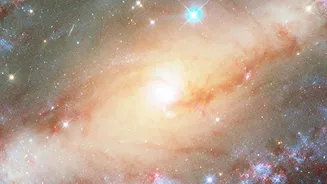
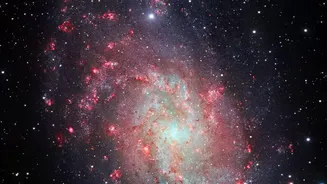
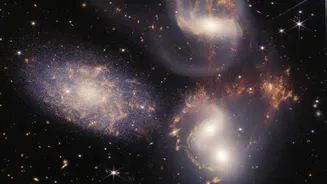
Galaxies aren't scattered randomly through space; they are arranged in a vast, interconnected structure of filaments and voids known as the 'cosmic web'. Roman’s High-Latitude Wide-Area Survey is specifically designed to map this structure on a grand scale. By surveying billions of galaxies over about 12 percent of the sky, the telescope will create the most extensive 3D map of the universe ever produced. To build a three-dimensional map, you need more than just a position on the sky; you need distance. Roman will achieve this using spectroscopy, a technique that splits a galaxy's light into its component colors. By analyzing these light patterns, astronomers can measure how much a galaxy's light has been stretched by the expansion of the universe, a phenomenon known as redshift. This measurement reveals the galaxy's distance, adding the crucial third dimension to the map.
Shedding Light on Dark Mysteries
The primary driver for creating this massive galactic map is to confront the two biggest puzzles in cosmology: dark energy and dark matter. Together, they are believed to make up about 95% of the universe, yet we cannot see or directly detect them. Dark energy is the mysterious force thought to be causing the universe's expansion to accelerate. By precisely plotting the positions of millions of galaxies across cosmic time, Roman will track the history of this expansion. The patterns in how galaxies cluster together at different eras will reveal how dark energy's influence has changed over billions of years, giving scientists crucial data to test their theories. At the same time, the telescope will map the distribution of dark matter. While invisible, dark matter's gravity warps spacetime, subtly distorting the light from distant galaxies that passes by it—an effect called weak gravitational lensing. By measuring the tiny changes in the shapes of hundreds of millions of galaxies, Roman will create a detailed map of the intervening dark matter, revealing its structure and behavior like never before.
More Than Just a Mapmaker
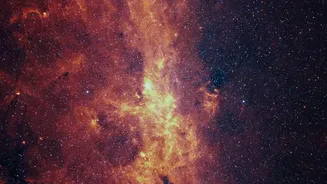
While its galaxy survey is a cornerstone of the mission, Roman's capabilities extend far beyond mapping. The same wide, deep, and rapid surveys will be a treasure trove for other astronomical fields. The mission is expected to discover thousands, and potentially more than 100,000, new planets beyond our solar system using techniques like gravitational microlensing and transits. By repeatedly observing the crowded central bulge of our own Milky Way galaxy, Roman will detect the tell-tale brightening of a distant star as a planet passes in front of it, acting as a gravitational lens. It will also capture thousands of Type Ia supernovae—exploding stars that serve as 'standard candles' to measure cosmic distances with extreme precision. These observations will provide an independent method for studying the universe's expansion. Furthermore, Roman is powerful enough to spot the flare-ups that occur when stars are torn apart by supermassive black holes in the early universe, helping us understand how these cosmic giants grow.