


A Cosmic Crowd in the Ancient Universe
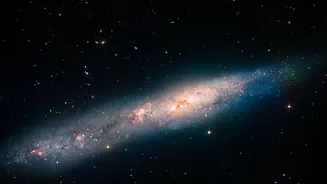
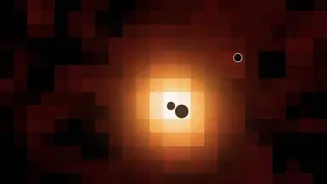
In a remarkable discovery, an international team of astronomers has found the first evidence for a trio of actively feeding supermassive black holes within a single galaxy. This isn't just any galaxy; it's an incredibly distant one catalogued as J0148-4214.
The light from this system has travelled for more than 12.5 billion years to reach us, meaning we are seeing it as it existed just 1.2 billion years after the Big Bang. This finding provides a stunning snapshot of the universe in its infancy. Led by researchers from the Max Planck Institute for Extraterrestrial Physics, the study used the powerful James Webb Space Telescope (JWST) to peer back in time. What they found challenges our understanding of how the largest structures in the cosmos came to be. It suggests that the processes bringing massive galaxies—and their monstrous central black holes—together were happening much earlier and more efficiently than previously thought.
How to Spot Three Giants
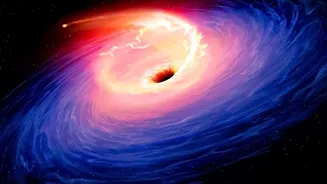
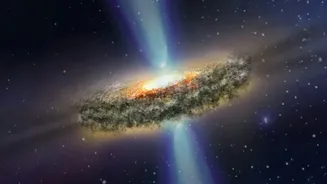
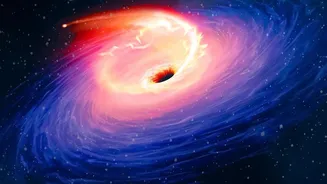
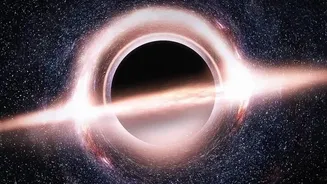
You can't see a black hole directly, especially not from 12.5 billion light-years away. Instead, astronomers look for the tell-tale signs of their presence. Supermassive black holes at the centers of galaxies become brilliantly luminous 'quasars' when they are actively pulling in huge amounts of gas and dust. This material forms a swirling, superheated accretion disk around the black hole, which shines brighter than entire galaxies. The team behind this discovery used the JWST’s Near Infrared Spectrometer (NIRSpec) to analyse the light from J0148-4214. They didn't see three separate points of light. Instead, they detected the spectral fingerprints of hydrogen gas moving at incredible speeds under the gravitational influence of three distinct massive objects. Two of the black holes are located very close to each other in the galaxy's core—separated by only about 620 light-years—while a third is situated further out. It’s a feat of cosmic detective work, using subtle shifts in light to reveal a complex and crowded galactic core.
A Puzzle for Galaxy Formation
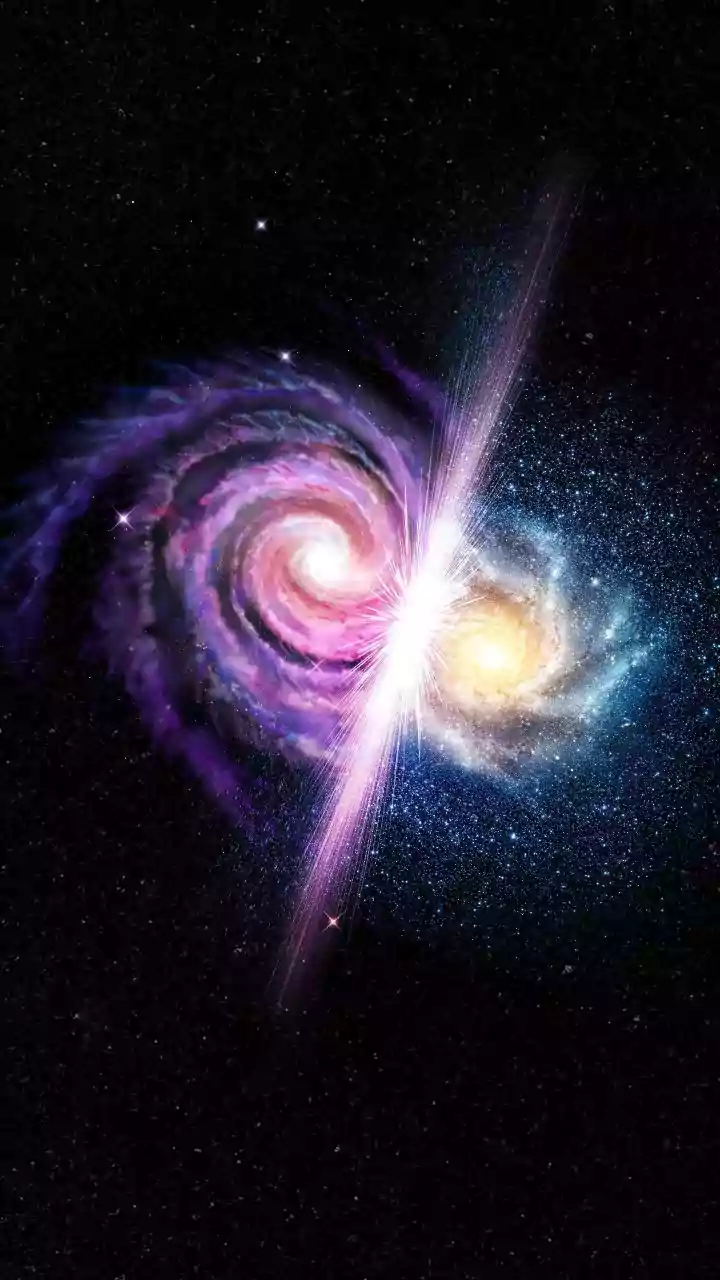
Finding one supermassive black hole in the early universe is expected. Finding two suggests a galactic merger. But finding three crammed into one system throws a wrench into some long-held theories of galaxy evolution. Scientists believe that galaxies grow by colliding and merging with other galaxies. When this happens, their central black holes eventually sink towards the new galactic center and merge as well, creating an even larger black hole. The discovery of a triple system so early in cosmic history suggests these mergers were frequent and perhaps involved multiple galaxies at once. The black holes in J0148-4214 have estimated masses of 80 million, 2 million, and 0.6 million times that of our sun. Their existence in such close proximity provides a key piece of evidence supporting the theory that mergers are a primary driver for the rapid growth of supermassive black holes in the ancient universe.
What Comes Next?
This triple system is not a stable arrangement. The two central black holes, with masses of 80 million and 0.6 million suns, are on an inevitable collision course. Astronomers predict they will merge within the next few hundred million years. Three-body gravitational systems are inherently chaotic, and it's possible that one of the black holes could eventually be ejected from the galaxy altogether. For now, this discovery provides a unique laboratory for studying the end-stage of galaxy mergers. Future observatories, particularly those designed to detect gravitational waves—the ripples in spacetime created by massive collisions—may one day be able to observe the final, violent merger of systems like this one. This finding opens a new window into the chaotic, brilliant, and formative years of our universe, showing that galactic families were sometimes far more complicated than we ever imagined.