







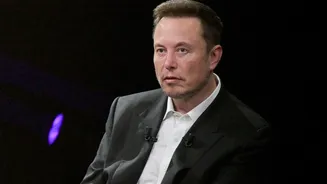
Musk's Latest Bombshell
In a recent interview, the CEO of Tesla, SpaceX, and xAI declared that artificial intelligence may exceed the sum of all human intelligence within the next five years. He envisions this leading to an “age of amazing abundance where anyone can have anything
they can think of,” provided humanity avoids a major catastrophe. This marks a significant shortening of his previous timelines, which had placed this milestone closer to the end of the decade. Musk's evolving perspective has shifted from what he once described as a transition from "exhilaration to terror" to a more accepting philosophy of, "Let's enjoy the ride." He now argues that the momentum of AI development is unstoppable, and instead of trying to hit a non-existent stop button, the focus should be on managing the risks.
Decoding Superintelligence
So, what is the superintelligence Musk is talking about? It’s formally known as Artificial Superintelligence, or ASI. This isn't the AI we use today, like ChatGPT or image generators, which are forms of ‘narrow AI’ designed for specific tasks. ASI is a hypothetical future AI that would not just match, but vastly surpass human intellect in virtually every field — from scientific creativity and problem-solving to emotional understanding and social skills. It represents the point where a machine becomes self-aware and capable of continuous self-improvement, leading to an intelligence explosion far beyond human comprehension. The journey to ASI is often seen as passing through Artificial General Intelligence (AGI), where an AI achieves human-level cognitive abilities across the board. Musk's prediction implies we will leapfrog from our current state to ASI in a historically short timeframe.
The Expert Reality Check
While Musk’s predictions generate headlines, many experts in the AI field urge caution. There is a significant debate among researchers about the timeline to AGI, let alone ASI. Some, like Meta’s chief AI scientist Yann LeCun, are highly skeptical of such short timelines, pointing to fundamental limitations in current AI architectures. Others, like investor Michael Burry, have pushed back on Musk’s vision of effortless abundance, warning that the transition could be chaotic and disruptive. The field is broadly split. On one side are the 'accelerationists' who, like Musk, believe rapid progress is inevitable and largely beneficial. On the other are those who argue for a more cautious, deliberate approach, highlighting that we are still far from solving basic challenges in making AI truly robust and reliable. The consensus is that while AI is advancing at an unprecedented rate, a five-year jump to superintelligence remains a highly optimistic, if not outright speculative, forecast.
A History of Audacious Timelines
To understand this latest forecast, it helps to look at Musk’s track record. The billionaire entrepreneur is famous for setting incredibly ambitious, often-missed deadlines. For years, he has predicted the imminent arrival of fully autonomous cars. In 2016, he suggested Tesla vehicles would be capable of complete autonomy within two years. A decade later, Tesla's "Full Self-Driving" is still classified as a Level 2 driver-assistance system, requiring constant human supervision. Similarly, his timelines for colonizing Mars have consistently shifted, with predictions for the first human arrivals moving from 2024 to 2029 and beyond. This pattern of 'optimistic forecasting' is part of the Musk playbook. It creates a sense of urgency, attracts talent, and pushes his teams to their limits, even if the stated goals aren't met on the initial schedule.